
Brief Context
Context Gene drive technology is emerging as a novel approach to genetically modify mosquitoes to prevent the transmission of Malaria. Global burden of Malaria According to the World malaria report, there were 282 million cases of malaria in 2024, with an estimated number of malaria deaths standing at 610 000. The WHO African Region is home to about 95% of all malaria cases and deaths.
Source Content
Syllabus: GS2/ Health, GS3/ Science and Technology
Context
- Gene drive technology is emerging as a novel approach to genetically modify mosquitoes to prevent the transmission of Malaria.
Global burden of Malaria
- According to the World malaria report, there were 282 million cases of malaria in 2024, with an estimated number of malaria deaths standing at 610 000.
- The WHO African Region is home to about 95% of all malaria cases and deaths. Children under 5 years of age accounted for about 76% of all malaria deaths in the Region.
What are Gene Drives?
- A gene drive is a genetic engineering technology that biases inheritance patterns, ensuring that a specific gene is passed on to a disproportionately large share of offspring.
- It operates using CRISPR-Cas9, which enables precise modification and copying of genes during reproduction.
- Unlike normal inheritance where a gene has a 50% chance of transmission, gene drives can ensure inheritance rates exceeding 90%, allowing rapid spread through a population.
Tanzania ‘Transmission Zero’ Study
- Genetically modified mosquitoes significantly inhibited parasite development when fed on blood samples from infected individuals.
- In several cases, parasites failed to reach the infectious stage, thereby preventing transmission.
What are the Concerns?
- Scientific and Technical Challenges: The genetic diversity of malaria parasites requires multi-targeted interventions to prevent resistance. There is a possibility of evolutionary adaptation in both mosquitoes and parasites.
- Ecological Risks: Altering or suppressing mosquito populations may have unintended ecological consequences, as mosquitoes play roles in food chains and ecosystems.
- Regulatory and Governance Challenges: Deployment requires robust biosafety frameworks, risk assessments, and global cooperation.
What is Malaria?
- Malaria is a life-threatening disease spread to humans by some types of mosquitoes. It is mostly found in tropical countries.
- Transmission: It is caused by plasmodium protozoa. The plasmodium parasites spread through the bites of infected female Anopheles mosquitoes. Blood transfusion and contaminated needles may also transmit malaria.
- Types of parasites: There are 5 Plasmodium parasite species that cause malaria in humans and 2 of these species – P. falciparum and P. vivax – pose the greatest threat. The other malaria species which can infect humans are P. malariae, P. ovale and P. knowlesi.
- P. falciparum is the deadliest malaria parasite and the most prevalent on the African continent. P. vivax is the dominant malaria parasite in most countries outside of sub-Saharan Africa.
- Symptoms: Fever and flu-like illness, including chills, headache, muscle ache and fatigue.
- Vaccine: Since 2021, WHO has recommended broad use of the RTS,S/AS01 malaria vaccine among children living in regions with moderate to high P. falciparum malaria transmission.
- In 2023, WHO recommended a second malaria vaccine, R21/Matrix-M.
India’s Commitment and National Goals
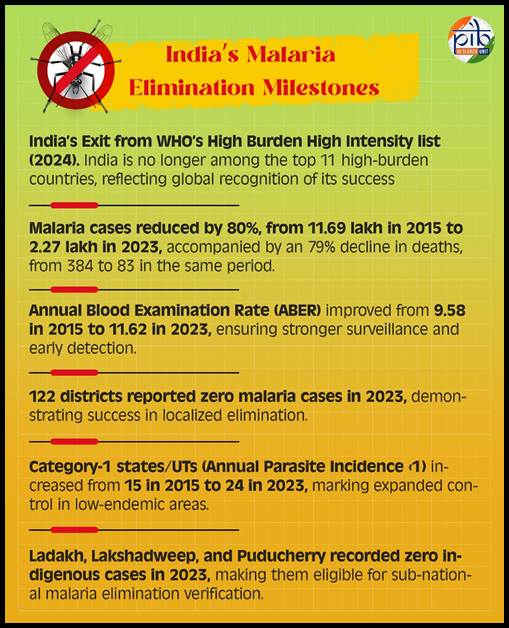
- India remains steadfast in its commitment to eliminate malaria by 2030, with the intermediate target of zero indigenous cases by 2027. The strategic roadmap for this mission is guided by:
- The National Framework for Malaria Elimination in India (2016–2030) outlines the vision, goals, and targets for phased malaria elimination.
- The National Strategic Plan for Malaria Elimination (2023–2027) builds upon earlier frameworks and aligns with the WHO Global Technical Strategy for Malaria 2016–2030.
Source: TH