
Brief Context
Context Undersea cable damage in the Red Sea has slowed internet access across several countries in Asia and the Middle East, including India. What are Submarine Cables? Definition: Submarine cables are fiber optic cables laid on the ocean floor, connecting two or more landing points across countries and continents.
Source Content
Syllabus: GS3/ Science and Technology
Context
- Undersea cable damage in the Red Sea has slowed internet access across several countries in Asia and the Middle East, including India.
What are Submarine Cables?
- Definition: Submarine cables are fiber optic cables laid on the ocean floor, connecting two or more landing points across countries and continents.
- India’s Role: India is a significant player in the global submarine cable network, with 17 international cables and 14 landing stations in cities like Mumbai and Chennai.
- As of the end of 2022, the total lit capacity and activated capacity of these cables stood at 138.606 Tbps and 111.111 Tbps, respectively.
- Significance: Submarine cables form the backbone of the global digital economy, carrying over 99% of international data exchange.
- They support critical services like e-commerce, financial transactions, and global communications.
What Is a Fiber Optic Cable?
- A fiber-optic cable is a type of networking cable that uses light to transmit data through thin strands of glass or plastic called optical fibers.
- Fiber-optic cables transmit data using pulses of light based on the principle of total internal reflection.
- Main Elements of Fiber Optics:
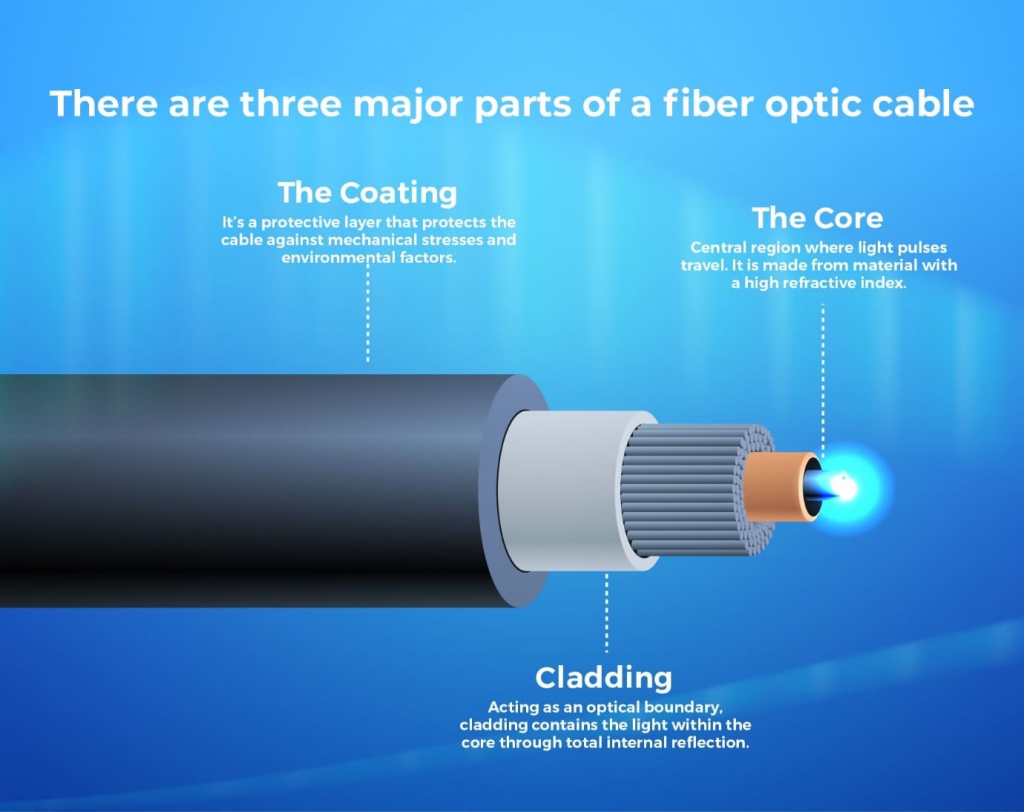
- The core: Data signals are converted into light pulses and sent through the core, a thin glass or plastic strand at the center of the fiber.
- The cladding: Surrounding the core is the cladding, another layer of glass with a lower refractive index. The difference in refractive index causes the light to bounce repeatedly off the cladding and stay contained within the core.
- Buffer Coating: A plastic coating that protects the core and cladding from damage.
- The detector: At the receiving end, a photodetector converts the light pulses back into electrical signals that a computer or other device can understand.
| International Advisory Body for Submarine Cable Resilience – The International Telecommunication Union (ITU) and the International Cable Protection Committee (ICPC) jointly launched the International Advisory Body for Submarine Cable Resilience. 1. This initiative aims to strengthen the resilience of submarine cables. – The Advisory Body will also provide strategic guidance to address challenges related to increasing traffic, aging infrastructure, and growing environmental threats to submarine cables. International Cable Protection Committee (ICPC) – ICPC, founded in 1958, is a global forum for governments and commercial entities involved in the submarine cable industry. – Its primary mission is to enhance the security of undersea cables by providing a platform for exchanging technical, legal, and environmental information. |
Source: D News