
Brief Context
Context Scientists have developed a scalable next-generation device that produces green hydrogen by splitting water molecules using only solar energy. What is hydrogen? Hydrogen is the chemical element with the symbol H and atomic number 1.
Source Content
Syllabus: GS3/ Energy
Context
- Scientists have developed a scalable next-generation device that produces green hydrogen by splitting water molecules using only solar energy.
About the New Device
- Core Innovation: The device uses a silicon-based photoanode with n-i-p heterojunction architecture, composed of:
- n-type TiO₂
- intrinsic Si (undoped)
- p-type NiO
- Fabrication: Done through magnetron sputtering, an industry-ready, scalable method.
- This new device has high efficiency, low energy input, robust durability, and cost-effective materials.
What is hydrogen?
- Hydrogen is the chemical element with the symbol H and atomic number 1.
- Hydrogen is the lightest element and the most abundant chemical substance in the universe, constituting roughly 75% of all normal matter.
- It is colorless, odorless, tasteless, non-toxic, and highly combustible gas.
What is Green Hydrogen?
- Green Hydrogen: The hydrogen produced via electrolysis, the splitting of water into hydrogen and oxygen with electricity generated from renewable energy sources such as solar or wind, is known as Green hydrogen.
- MNRE defines Green Hydrogen as having a well-to-gate emission (i.e., including water treatment, electrolysis, gas purification, drying and compression of hydrogen) of not more than 2 kg CO2 equivalent / kg H2.
- Gujarat’s Kandla port is the first in India to have an operational Green Hydrogen plant using indigenous Electrolysers.
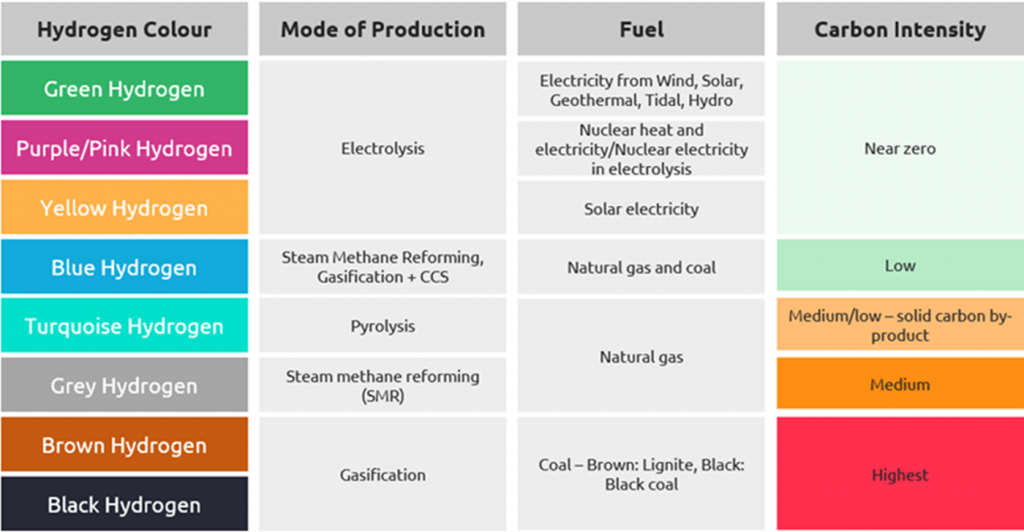
Significance of Green Hydrogen
- Energy Security: India is the third-largest oil consumer and fourth-largest crude oil importer, and hydrogen technology will play a key role in reducing this reliance.
- Industrial Decarbonisation: Can replace fossil fuels in hard-to-abate sectors – steel, cement, ammonia, refineries.
- Clean Mobility: Powering fuel cell vehicles, trains, and ships.
- Grid Stability: Acts as an energy storage medium for intermittent renewables.
Challenges
- Risks associated with the transportation: Hydrogen in gaseous form is highly inflammable and difficult to transport, thereby making safety a primary concern.
- High Production Costs: The levelized cost of electricity (LCOE) and electrolyzer costs are major factors driving up the overall production costs.
- Disparity in Production Costs: A substantial disparity between green hydrogen production costs ($5.30- $6.70 per kg) and traditional grey/blue hydrogen production costs ($1.9-$2.4 per kg).
- Technological Readiness: The adoption rates and risk factors associated with futuristic technologies pose challenges for financing and scaling up production.
Government initiatives for Green Hydrogen
- National Green Hydrogen Mission: The mission was launched in 2023 with an outlay of Rs. 19,744 crores. It lays out a comprehensive roadmap to:
- Identify and Create demand in potential sectors
- Provide production incentives for setting up domestic capacity
- Achieve 5 million metric tonnes of green hydrogen production by 2030.
- Averting nearly 50 MMT of CO2 emissions annually.
- Attract investments of about USD 100 billion.
- Generate over 600,000 jobs.
- The Green Hydrogen Certification Scheme is a framework established to ensure the transparent and credible certification of green hydrogen production in India.
- Green Hydrogen and Green Ammonia plants have been exempted from Environmental Clearance by the Ministry of Environment, Forest and Climate Change.
Progress
- The first batch of three hydrogen-powered heavy-duty trucks will operate on the Faridabad–Delhi NCR and Ahmedabad–Surat–Vadodara routes.
- To support this transition, Indian Oil Corporation Limited (IOCL) is establishing hydrogen refueling stations in Faridabad, Vadodara, Pune, and Balasore.
- Three major ports namely Kandla, Paradip and Tuticorin ports have been identified by the Ministry of Ports, Shipping and Waterways (MoPSW) to be developed as Green Hydrogen hubs.
Concluding remark
- India’s success in developing a solar-powered green hydrogen device signals the beginning of a transformative journey toward a decarbonised economy.
- However, translating scientific innovation into large-scale application will require coordinated efforts across policy, industry, and finance.
Source: PIB