
Brief Context
Context The National Council of Applied Economic Research (NCAER) released the report “India’s Employment Prospects: Pathways to Jobs”, Underlining the role of skilling and small enterprises as key drivers of job creation in the country. Key Findings of the Report Employment Trends: India’s self-employment dominance is due to economic necessity rather than entrepreneurial dynamism as most of the small enterprises function at subsistence level. Workforce Composition: India’s workforce could benef
Source Content
Syllabus: GS3/ Economy
Context
- The National Council of Applied Economic Research (NCAER) released the report “India’s Employment Prospects: Pathways to Jobs”, Underlining the role of skilling and small enterprises as key drivers of job creation in the country.
Key Findings of the Report
- Employment Trends: India’s self-employment dominance is due to economic necessity rather than entrepreneurial dynamism as most of the small enterprises function at subsistence level.
- Workforce Composition: India’s workforce could benefit greatly from upskilling, particularly with the advent of new technologies and AI.
- Medium-skilled jobs dominate employment growth, especially in services, whereas manufacturing remains low-skill intensive.
- Increasing the skilled workforce share by:
- 9 percentage points could generate 9.3 million jobs by 2030.
- 12 percentage points could raise employment in labour-intensive sectors by over 13% by 2030.
- Role of Small Enterprises: Productivity of India’s smallest enterprises is central to the country’s employment future.
- Enterprises using digital technologies employ 78% more workers than non-digital firms. A 1% increase in access to credit raises the expected number of hired workers by 45%.
What are the Challenges?
- Informal enterprises dominate India’s economy, especially Own Account Enterprises (OAEs) that do not hire workers.
- A 10% increase in GVA in informal enterprises can lead to a 4.5% rise in hired workers.
- Low Coverage of Formal Training: As of 2024, only 4.1% of India’s workforce had received formal vocational training.
- Structural Problems in the Skilling System:
- Training courses are poorly aligned with industry needs.
- Many training centres suffer from low seat utilisation.
- Placement outcomes remain weak.
- Limited coordination between industry, training providers and state governments.
Key government Initiatives
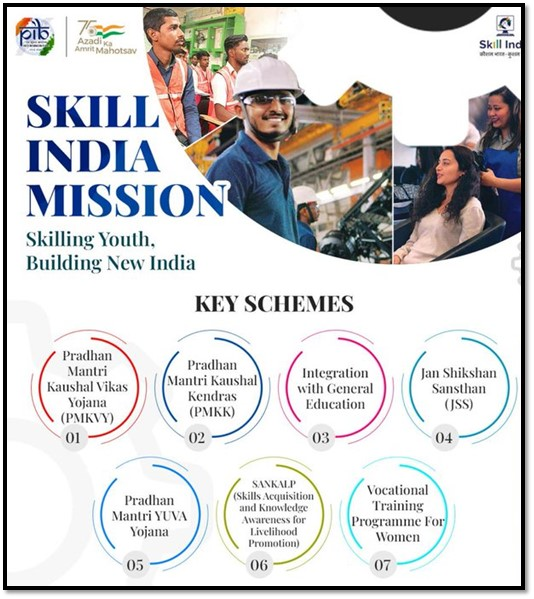
| National Skill Development Corporation (NSDC)
– NSDC was established in 2008, as a not-for-profit public limited company under section 25 of the Companies Act, 1956 (now section 8 of the Companies Act, 2013). |
Policy Recommendations Highlighted in the Report
- Reforming the Skilling Ecosystem:
- Shift from supply-driven training to demand-aligned skilling.
- Strengthen industry participation and placement-oriented outcomes.
- Increase public investment in vocational education.
- Demand-Side Employment Strategy:
- Prioritise labour-intensive manufacturing sectors such as textiles, garments, footwear, and food processing.
- Align industrial incentives with employment multipliers rather than output alone.
- Boosting Informal Sector Productivity:
- Expand access to formal credit for small and micro enterprises.
- Promote digital adoption to improve productivity and hiring capacity.
- Enable enterprise graduation from subsistence to growth-oriented models.
Source: AIR