
Brief Context
Context A United States-based bioscience company claimed that it had revived an extinct species of animal, the dire wolf. The Dire Wolf (Aenocyon dirus) The Dire wolf was one of the most formidable predators of the late Pleistocene epoch. Geographic Range: It lived across North America — from southern Canada to the United States, before they went extinct about 13,000 years ago.
Source Content
Syllabus: GS3/ Science and Technology
Context
- A United States-based bioscience company claimed that it had revived an extinct species of animal, the dire wolf.
The Dire Wolf (Aenocyon dirus)
- The Dire wolf was one of the most formidable predators of the late Pleistocene epoch.
- Geographic Range: It lived across North America — from southern Canada to the United States, before they went extinct about 13,000 years ago.
- Physical Traits: They resembled the grey/ gray wolves (Canis lupus), but were larger, with white coats.
- A dire wolf could be 3.5 feet tall, more than 6 feet in length, and weigh up to 68 kg.
- Diet: Predators of horses, bison, and possibly mammoths.
What Is De-Extinction?
- De-extinction, or resurrection biology, refers to the scientific process of bringing back extinct species or creating organisms closely resembling them through genetic engineering.
- De-extinction is possible because of bioengineering techniques that can manipulate DNA and genomes or the genetic material in an organism.
- The goal is to re-establish dynamic processes that produce healthy ecosystems and restore biodiversity.
Methods of De-Extinction
- Back-breeding: It uses the principles of selective breeding. This method works well when the extinct species are closely related to a still-living species.
- Limitation: It cannot recreate the exact genome of the extinct species. Risks include inbreeding and genetic mutations.
- Cloning: It produces a genetically identical copy of an organism through Somatic Cell Nuclear Transfer (SCNT).
- Example: Birth of Dolly the sheep in 1996.
- Limitation: It requires intact living cells, so it’s not feasible for long-extinct species.
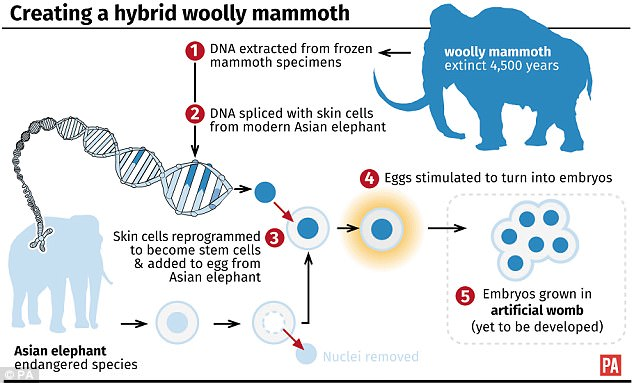
- Genome Editing & Synthetic Genomics: Genome editing tools (like CRISPR) allow for precise deletion, addition, or modification of genes.
- Synthetic genomics involves inserting large sections of synthesized DNA into a host genome.
- Result: Hybrid organisms with traits from both extinct and living species.
Concerns
- Ecological Disruption: The reintroduction of hybrid species may disturb present-day ecosystems.
- Genetic Health: High chances of mutations, low genetic diversity, and inbreeding.
- Habitat Availability: With the changing environment natural habitats may no longer exist.
Concluding remarks
- The revival of the dire wolf signifies a giant leap in genetic science but also opens up a Pandora’s box of ecological, ethical, and legal concerns.
- While de-extinction holds promise for biodiversity and conservation, its application must be cautious, well-regulated, and grounded in sustainability.
Source: IE