
Brief Context
Context Recently, the United Nations Development Programme (UNDP) released the Human Development Report (HDR) for 2025, highlighting Indias progress in life expectancy, education, and income levels. Human Development Index: Current Status Iceland (HDI value of 0.972), ranked at the top of the Index, followed by Norway and Switzerland. South Sudan was at the bottom at 193 with 0.388.
Source Content
Syllabus: GS3/Inclusive Growth
Context
- Recently, the United Nations Development Programme (UNDP) released the Human Development Report (HDR) for 2025, highlighting India’s progress in life expectancy, education, and income levels.
- It is titled as ‘A Matter of Choice: People and Possibilities in the Age of AI’, and explores AI’s role in shaping future development.
| Human Development Index (HDI) – Pakistani economist Mahbub ul Haq created the HDI in 1990 and was further used by UNDP in creating a report on the nation’s socio-economic achievement. – It evaluates three key dimensions and is calculated using a geometric mean of these three indices: 1. Health is measured by life expectancy at birth (SDG-3). 2. Education is assessed through mean years of schooling for adults (SDG-4.4) and expected years of schooling for children (SDG-4.3). 3. Standard of Living is evaluated using Gross National Income (GNI) per capita (SDG-8.5), adjusted for income distribution.
|

Human Development Index: Current Status
- Iceland (HDI value of 0.972), ranked at the top of the Index, followed by Norway and Switzerland.
- South Sudan was at the bottom at 193 with 0.388.
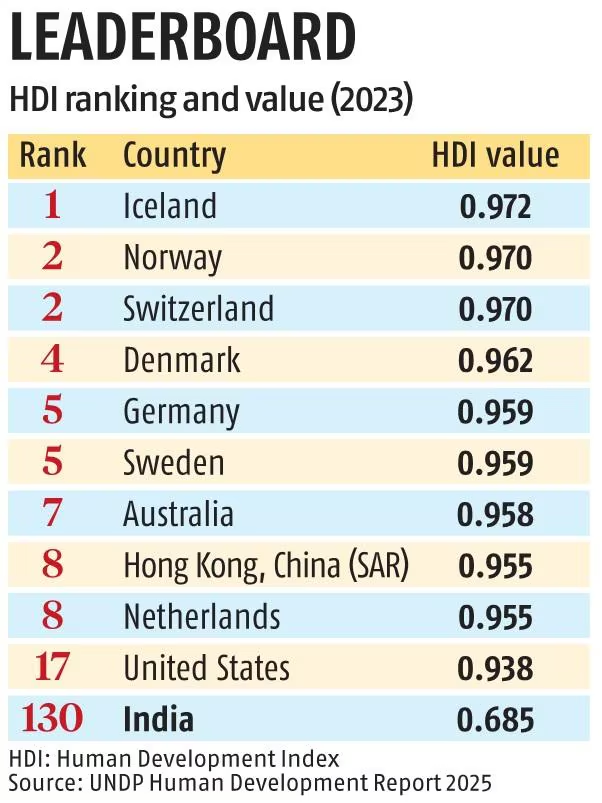
- India improved its HDI value from 0.676 in 2022 (133th) to 0.685 in 2023 (130th), remaining in the medium human development category.
- India’s HDI value has increased by over 53% since 1990, growing faster than both the global and South Asian averages.
- Among India’s neighbours, China (75th), Sri Lanka (78th) and Bhutan (127th) are ranked above India, while Bangladesh (130th) is ranked at par.
- Nepal (145th), Myanmar (149th), Pakistan (168th) are ranked below India.
Highlights of India’s HDI Progress
- Improved Life Expectancy: India’s life expectancy has risen from 58.6 years in 1990 to 72 years in 2023, marking its highest level since the index began.
- National health programs like Ayushman Bharat, Janani Suraksha Yojana, and Poshan Abhiyaan have contributed to this growth.
- Advancements in Education: The average years of schooling have increased from 8.2 years in 1990 to 13 years in 2023.
- Policies like the Right to Education Act, Samagra Shiksha Abhiyan, and National Education Policy 2020 have played a crucial role.
- Economic Growth and Poverty Reduction: India’s Gross National Income (GNI) per capita has risen over four times, from $2,167 in 1990 to $9,046 in 2023.
- 135 million Indians escaped multidimensional poverty between 2015-16 and 2019-21.
Key Challenges & Suggestions Made in Report
- AI and Human Development: HDR 2025 argues that AI should enhance human capabilities rather than replace them.
- It calls for bold policy decisions to ensure AI-driven growth benefits all communities.
- Widening Inequalities: Global inequalities are increasing, slowing human development progress, despite technological advancements.
- Income inequality reduces India’s HDI by 30.7%, one of the highest losses in the region.
- Gender disparities continue to affect education, employment, and healthcare access.
- The report urges inclusive AI policies to bridge the gap between developed and developing nations.
- Three Key Action Areas:
- Building a complementarity economy where humans and AI work together.
- Driving innovation to expand human capabilities.
- Investing in inclusive education, healthcare, and social protection systems.
Sources and further reading
- Source: THthehindu.com