
Brief Context
Context The 11th National Handloom Day was celebrated at Bharat Mandapam, New Delhi. National Handloom Day The handloom sector played a vital role in India’s freedom movement. The Swadeshi Movement, launched on August 7, 1905, championed indigenous industries, especially handlooms, as a form of economic resistance to colonial rule.
Source Content
Syllabus: GS3/Economy
Context
- The 11th National Handloom Day was celebrated at Bharat Mandapam, New Delhi.
National Handloom Day
- The handloom sector played a vital role in India’s freedom movement. The Swadeshi Movement, launched on August 7, 1905, championed indigenous industries, especially handlooms, as a form of economic resistance to colonial rule.
- In honour of this legacy, August 7 was declared National Handloom Day in 2015.
- It is celebrated annually and it recognises weavers’ contributions to the nation and promotes the preservation of India’s handloom heritage.
The Indian handloom industry
- India’s handloom sector is known for its wide range of fabrics, including cotton, khadi, jute, linen, and rare fibres like Himalayan nettle.
- It also produces distinctive silk varieties like Tussar, Mashru, Mulberry, Eri, Muga and Ahimsa, along with woollen weaves like Pashmina, Shahtoosh and Cashmere.
- It is one of the world’s oldest cottage industries, showcases the country’s rich cultural heritage and skilled craftsmanship.
- 95% of the world’s hand fabric comes from India.
- It is spread across villages and small towns and it relies on traditional hand-spinning, weaving, and printing techniques passed down through generations.
- Today, handloom weaving is India’s largest cottage industry. According to the 4th All India Handloom Census (2019–20), about 35.22 lakh households are involved in this work.
- Around 72% of economic handloom weavers are women.
- In the financial year 2024-25, the United States remained the largest destination, accounting for ₹331.56 crore worth of exports.
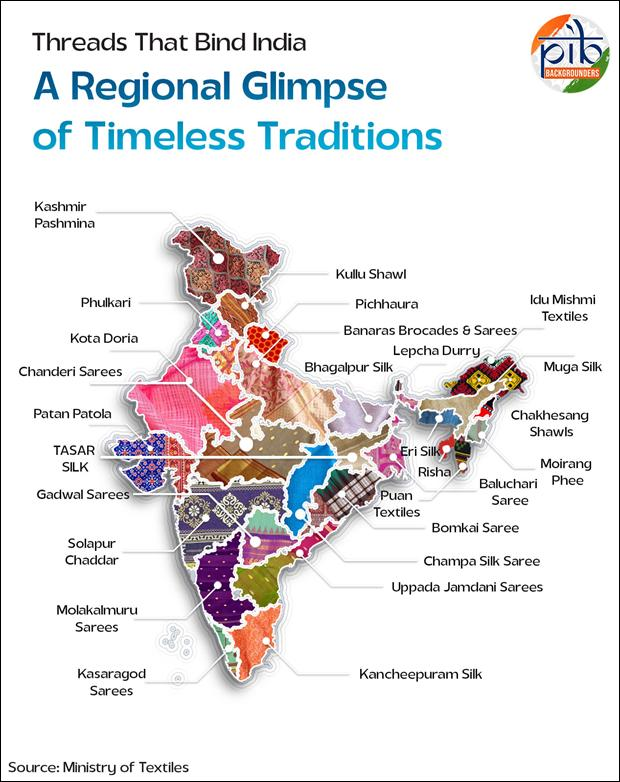
| Do you know? – Every region in India has developed its unique handloom style. – For example, Rajasthan is known for its tie and dye, Madhya Pradesh for Chanderi, and Uttar Pradesh for Jacquard patterns. – Other well-known styles include Bomkai from Odisha, Kunbi from Goa, Paithani from Maharashtra, Kotpad from Odisha, Balarampuram from Kerala, Jamdani and Baluchari from West Bengal. – Each piece is handmade using traditional methods, making every product unique.
|
Source :PIB