
Brief Context
Context BRICS nations have “condemned and rejected” the Carbon Border Adjustment Mechanisms (CBAM) of the European Union (EU) and similar restrictive trade measures, saying they undermine their transition to a cleaner economy. CBAM CBAM is an import duty imposed by the European Union (EU) on goods produced by processes that lead to more carbon emissions than domestic European manufacturers are allowed to emit. It is introduced to put a “fair price” on carbon-intensive goods imported from non-EU
Source Content
Syllabus: GS3/Environment, GS3/Economy
Context
- BRICS nations have “condemned and rejected” the Carbon Border Adjustment Mechanisms (CBAM) of the European Union (EU) and similar restrictive trade measures, saying they undermine their transition to a cleaner economy.
CBAM
- CBAM is an import duty imposed by the European Union (EU) on goods produced by processes that lead to more carbon emissions than domestic European manufacturers are allowed to emit.
- It is introduced to put a “fair price” on carbon-intensive goods imported from non-EU countries.
- It is to create a level playing field with EU companies that account for their carbon emission through the bloc’s Emission Trading System (ETS).
- Application: To be imposed from January 1, 2026, on six items: steel, aluminium, cement, fertilizer, hydrogen, and electricity.
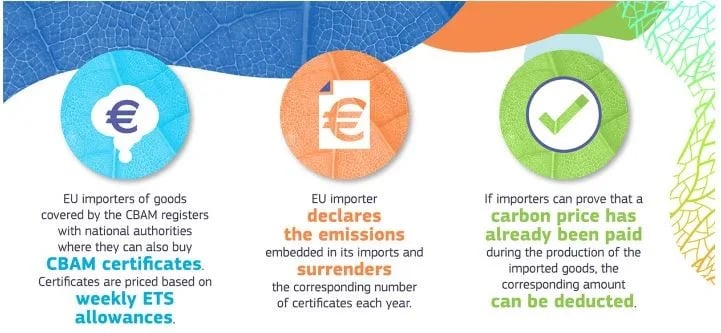
Concerns of Developing Nations
- Environmental Compliance: Discussions on CBAM are happening under the Trade and Technology Council (TTC), with India and developing nations arguing that environmental issues shouldn’t be tied to trade.
- Impact on Exports: The policy hurts the export competitiveness of developing countries such as China and India.
- CBAM could affect 43% of India’s exports to the EU, including metals, textiles, chemicals, electronics, and vehicles.
- CBAM could impose a 20-35% tax on specific imports like steel and aluminium.
- India’s metal sector is most vulnerable, with exports worth over $8 billion at risk.
- Violation of International Agreements: The Paris Agreement adopted in 2015 protects developing countries from the social and economic impacts of “response measures” against climate change.
- Dubai climate meeting (COP28) in 2023 acknowledged that “measures taken to combat climate change, including unilateral ones, should not constitute a means of arbitrary or unjustifiable discrimination or a disguised restriction on international trade”.
- Benefits Developed World: Industries in developed economies with emissions standards comparable to the EU’s stand to benefit from a CBAM-like measure.
- CBAM, therefore, can have the net effect of helping industries in the developed world, while putting those in developing countries at a disadvantage.
Way Ahead for India on CBAM
- Strengthen Global Negotiations through Alliances: India can actively collaborate with other developing countries, especially under platforms like the Trade and Technology Council (TTC), G77, and BASIC group, to push for a fair and equitable global carbon policy.
- Build Domestic Carbon Competitiveness: Invest in green technologies, cleaner industrial processes, and carbon accounting mechanisms to align with global emission norms.
- Establish a Carbon Market Framework: Developing a robust carbon market domestically, as India has already proposed, can help internalize carbon pricing and provide a benchmark that can be negotiated internationally.
- Sectoral Support for Affected Industries: Provide financial, technological, and policy support to vulnerable sectors such as steel, aluminium, and chemicals to help them reduce emissions intensity and comply with international standards.
- Develop a Counter-Policy Framework: India can consider formulating its own carbon border policy or tax incentives for green manufacturing, ensuring a level playing field domestically while signaling its readiness for fair environmental trade practices.
- Leverage EU–India Trade Talks: Use ongoing Free Trade Agreement (FTA) negotiations with the EU to seek exemptions, transitional arrangements, or mutual recognition mechanisms for Indian exporters under CBAM.
Source: IE
Sources and further reading
- Free Trade Agreementnextias.com
- IEindianexpress.com