
Brief Context
Context China officially commenced construction of a massive hydropower project on the Brahmaputra River in Tibet, near the Indian state of Arunachal Pradesh. Coordination Mechanism for Cooperation Between India and China: There is an umbrella Memorandum of Understanding on cooperation on transboundary rivers, and two separate MoUs on the Brahmaputra and Sutlej. The Brahmaputra MoU, renewable every five years, lapsed in 2023.
Source Content
Syllabus: GS2/ International Relations
Context
- China officially commenced construction of a massive hydropower project on the Brahmaputra River in Tibet, near the Indian state of Arunachal Pradesh.
About
- The project is being hailed as the largest infrastructure development of its kind globally.
- Project Details:
- It comprises five cascade hydropower stations.
- Total estimated investment: 1.2 trillion yuan (approx. USD 167.8 billion).
- Expected power generation: 300 billion kilowatt-hours annually — enough to power 300 million people.
- Location: Situated in the Yarlung Tsangpo Grand Canyon (Brahmaputra in Tibet), where the river takes a U-turn near the India-China border before entering Arunachal Pradesh and eventually Bangladesh.
- The region is seismically active and ecologically sensitive.
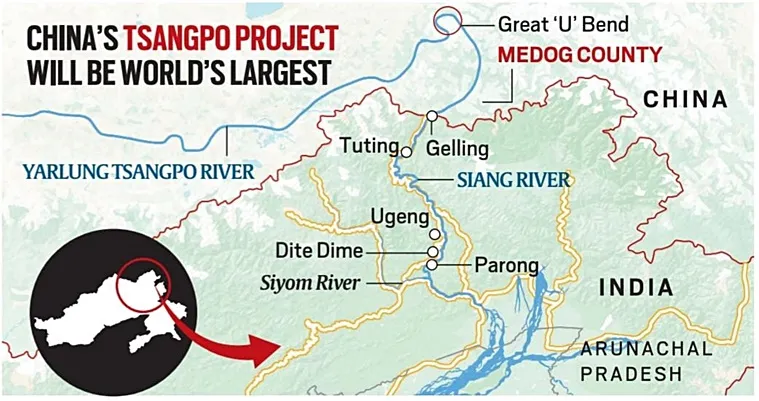
| Yarlung Tsangpo ( Zangbo) river – It originates from Chemayungdung Glacier in Tibet, and enters Arunachal Pradesh, where it is known as the Siang. – In Assam, it is joined by tributaries such as Dibang and Lohit, and is called the Brahmaputra. – The river then enters Bangladesh, and makes its way to the Bay of Bengal. – The basin spreads approximately 5,80,000 square kilometers across China (50.5%), India (33.3%), Bangladesh (8.1%) and Bhutan (7.8%). |
Impact of the Project
- Geopolitical Concerns: India and Bangladesh are lower riparian states.
- Both rely heavily on the uninterrupted flow of the Brahmaputra for agriculture, drinking water, and ecosystem stability.
- Concerns centre around disruptions to water flow, blocking of nutrient-rich silt, and potential ecological damage.
- It could also enable China to release large amounts of water flooding border areas in times of hostilities.
- Ecological Risks: Threat to biodiversity and river ecosystems, including aquatic species and wetlands.
- Seismic and Structural Risks: The Brahmaputra basin is seismically active, as evidenced by the 1950 Assam-Tibet earthquake.
- A mega-dam in this zone could trigger disasters like dam collapse and floods due to structural failure.
- Geopolitical Tensions: Control over water resources may heighten tensions between China and lower riparian countries (India, Bhutan, Bangladesh).
- Disaster Vulnerability: Increased risk of Glacial Lake Outburst Floods (GLOFs), as seen in the 2023 Sikkim floods.
Coordination Mechanism for Cooperation Between India and China:
- There is an umbrella Memorandum of Understanding on cooperation on transboundary rivers, and two separate MoUs on the Brahmaputra and Sutlej.
- The Brahmaputra MoU, renewable every five years, lapsed in 2023.
- The umbrella MoU was signed in 2013, and has no expiry date.
- China and India have the Expert Level Mechanism (ELM) since 2006 for hydrological data sharing, but lack a comprehensive treaty.
- None of the riparian nations (China, India, Bhutan, Bangladesh) are signatories to the UN Convention on the Law of the Non-navigational Uses of International Watercourses (1997).
Way Ahead
- Strengthen diplomatic dialogue: Between China, India, Bhutan, and Bangladesh for transparent water-sharing agreements.
- Institutional Mechanism: Establish a permanent transboundary river management authority for data-sharing on water flow, dam operations, and disaster forecasting.
- Disaster Preparedness: Enhance regional cooperation for disaster management, including shared resources for relief efforts.
- India’s Counter-Strategy: India is accelerating its own hydropower projects on the Brahmaputra in Arunachal Pradesh as part of regional infrastructure and border development.
Source: IT