
Brief Context
In News A cloudburst over the Kheer Ganga River (a tributary of Alaknanda River) led to flash floods in the high altitude villages of Dharali in Uttarakhands Uttarkashi district. What is Cloudburst? A cloudburst is a localized, extremely intense rainfall event where more than 100 mm of rain falls within an hour over a small area (typically about 10 km²).
Source Content
Syllabus: GS1/ Geography
In News
- A cloudburst over the Kheer Ganga River (a tributary of Alaknanda River) led to flash floods in the high altitude villages of Dharali in Uttarakhand’s Uttarkashi district.
What is Cloudburst?
- A cloudburst is a localized, extremely intense rainfall event where more than 100 mm of rain falls within an hour over a small area (typically about 10 km²).
- Cloudbursts are particularly common in mountainous regions, such as the Himalayas, due to topographical and meteorological factors.
Reasons for Cloudbursts
- Orographic Lifting: Moist air is forced upwards by mountains, causing it to cool and condense rapidly, resulting in intense rainfall.
- Upward Air Currents: Strong vertical currents can suspend raindrops at high altitudes; if these currents suddenly weaken, accumulated water falls in a short burst.
- Monsoon Dynamics: In India, monsoon clouds traveling from the Bay of Bengal or Arabian Sea rise sharply upon hitting the Himalayas, creating optimal conditions for cloudbursts.
- Climate Change: Rising global temperatures allow the atmosphere to hold more moisture, increasing both the frequency and intensity of cloudbursts in recent years.
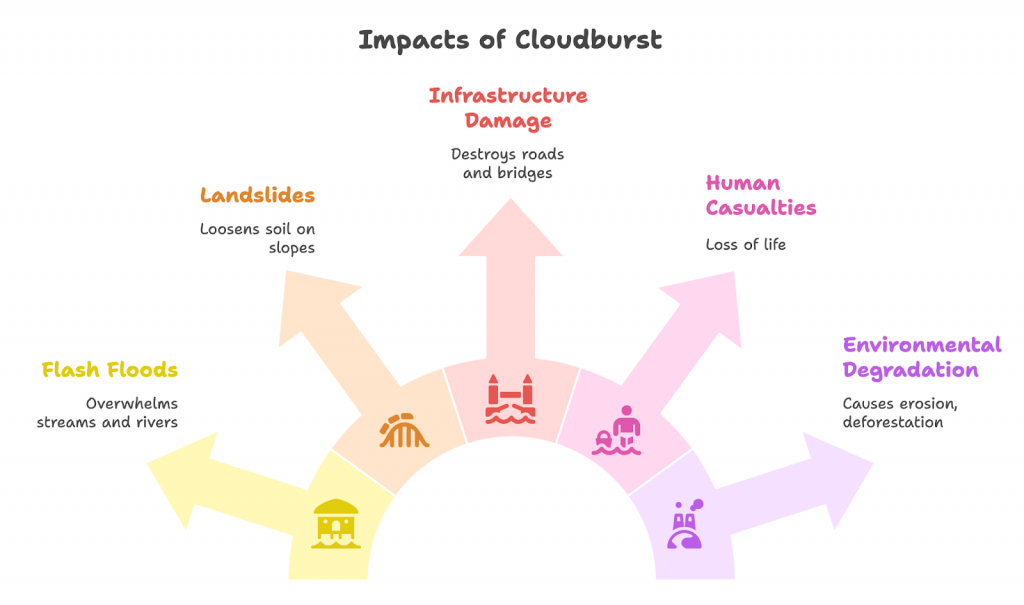
Way Ahead
- Strengthen Forecasting: Invest in advanced weather radar, satellite, and ground sensor networks for hyperlocal early warning. Real-time data sharing and targeted alerts must reach vulnerable communities directly.
- Ecosystem Restoration: Promote afforestation, watershed management, and stricter regulation of land use to restore the natural ability of slopes and valleys to absorb intense rainfall. Restrict unplanned construction in high-risk zones.
- Disaster-Resilient Infrastructure: Upgrade existing infrastructure (roads, bridges, hydropower plants) with climate-resilient standards. Ensure drainage systems can handle sudden runoff, and build robust evacuation and emergency shelters.
- Research and Capacity Building: Encourage ongoing research on climate change impacts, cloudburst prediction, and local vulnerability mapping.
- Community Awareness and Preparedness: Expand training in disaster response and evacuation at the community level, including regular drills in schools and public places.
Source: TOI