
Brief Context
Context Recently, the Ministry of Road Transport and Highways (MoRTH) released its Road Accidents in India 2023 report following a Supreme Courts direction after several delays. Key Causes of Road Accidents Overspeeding (68%): The leading cause of fatalities. Driving beyond speed limits reduces reaction time and increases impact severity.
Source Content
Syllabus: GS3/Infrastructure
Context
- Recently, the Ministry of Road Transport and Highways (MoRTH) released its ‘Road Accidents in India 2023‘ report following a Supreme Court’s direction after several delays.
Key Findings of Report
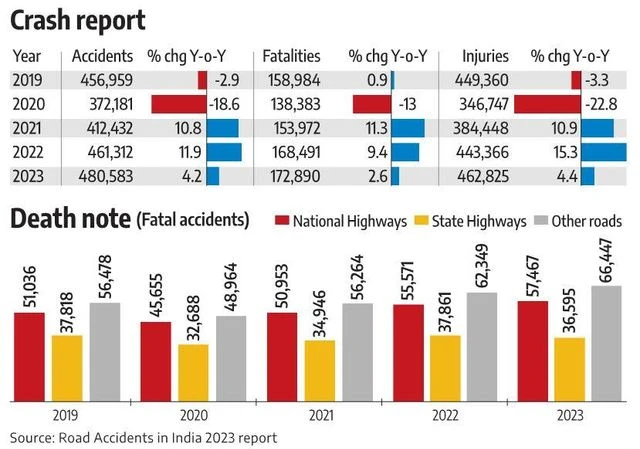
- Surge in Road Crashes & Death: Road accidents in India grew 4.2% year-on-year in 2023, reaching 480,583 cases. These accidents claimed 172,890 lives – the highest ever recorded.
- The number of deaths rose 2.6% compared to 2022, while 462,825 people were injured – a 4.4% increase.
- Surge in Fatal Accidents: Fatal road accidents increased from 1,55,781 in 2022 to 1,60,509 in 2023, marking a 3.04% growth.
- These accounted for 33.4% of all accidents, with a fatal accident defined as one causing two or more deaths.
- Who’s Most at Risk?
- Young Adults (18–45 years): Accounted for 66.4% of fatalities;
- Working Age Group (18–60 years): Made up 83.4% of total deaths;
- Two-Wheeler Users: Represented 44.8% of all fatalities;
- Pedestrians: Nearly 20% of deaths;
- Children: Over 9,489 lives lost in 2023 alone;
Key Causes of Road Accidents
- Overspeeding (68%): The leading cause of fatalities. Driving beyond speed limits reduces reaction time and increases impact severity.
- Driving on the Wrong Side (5.5%): Includes wrong-way driving on one-ways or overtaking from the left. Often leads to head-on collisions.
- Distracted Driving: Use of mobile phones, eating, or adjusting controls while driving contributes significantly to crashes.
- Drunk Driving: Alcohol impairs judgment, reflexes, and coordination, making it a persistent risk factor.
- Poor Road Conditions: Potholes, unmarked speed breakers, and lack of signage increase accident likelihood, especially in rural areas.
- Vehicle Defects: Brake failure, tire bursts, and other mechanical issues can trigger loss of control.
- Weather and Visibility: Fog, rain, and low light conditions reduce visibility and traction, leading to more accidents.
- Neglecting Safety Gear: Not wearing helmets or seatbelts drastically increases the risk of fatal injuries.
Key Efforts For Road Safety in India
- Road Safety as a Fundamental Right: The right to safe road travel is an essential component of the right to life under Article 21 of the Indian Constitution.
- Bharat New Car Assessment Programme (Bharat NCAP): It provides safety ratings for passenger cars, empowering consumers to make informed decisions.
- Vehicle Scrapping Policy: The government has implemented a vehicle scrapping policy, with 44 Registered Vehicle Scrapping Facilities operational across 15 states, to remove unsafe vehicles from roads.
- Electronic Enforcement Mechanisms: Speed cameras, CCTV surveillance, and automated traffic enforcement systems have been deployed to improve compliance with road safety regulations.
- Emergency Care Initiatives: The Motor Vehicles (Amendment) Act, 2019 introduced a cashless treatment scheme for accident victims during the golden hour, ensuring timely medical intervention.
- Targeted Interventions of Ministry of Road Transport and Highways (MoRTH):
- Rectification of over 5,000 black spots on highways;
- Mandatory road safety audits to assess risk areas;
- Stricter vehicle safety norms, including airbags and anti-lock braking systems;
- Electronic enforcement mechanisms such as speed cameras and CCTV surveillance to improve compliance;
- District-wide driving training and vehicle fitness centers to reduce accidents caused by unskilled driving;
Global Efforts
- Brasilia Declaration (2015): It defined the urgent measures needed to achieve the 2030 Agenda for Sustainable Development’s ambitious target (Target 3.6) to halve road traffic deaths by the end of this decade.
- United Nations Decade of Action for Road Safety (2021–2030): It aims to halve deaths related to road accidents by 2030.
- It aligns with the Stockholm Declaration (2020).
- World Bank Report (2020): It estimates that an additional $109 billion are required over the next decade to achieve a 50% reduction in road crash fatalities.
Key Committees & Policy Frameworks
- Sundar Committee on Road Safety and Traffic Management (2005):
- It recommended the creation of a National Road Safety Policy, approved by the Union Cabinet in 2010.
- It also proposed the establishment of a National Road Safety Board to oversee safety regulations and enforcement.
- National Road Safety Council (NRSC): As an advisory body under MoRTH, to provide recommendations on policy measures, enforcement strategies, and infrastructure improvements.
- Working Group on Road Safety Education:
- It focuses on driver training, public awareness campaigns, and school-level road safety education.
- It advocates for stronger enforcement of traffic laws and integration of road safety into school curricula.
- Supreme Court’s Committee on Road Safety:District Road Safety Committees for each district in the State, in accordance with The Motor Vehicle Act, 1988.
- It focuses on 4Es viz Engineering, Education, Enforcement & Emergency.