
Brief Context
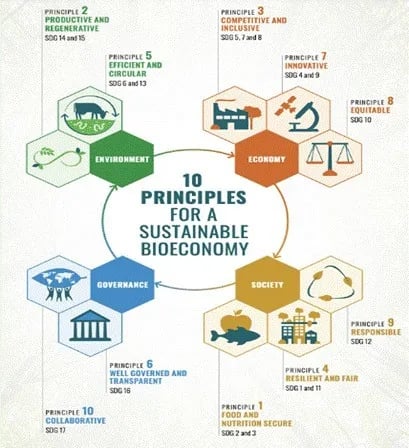
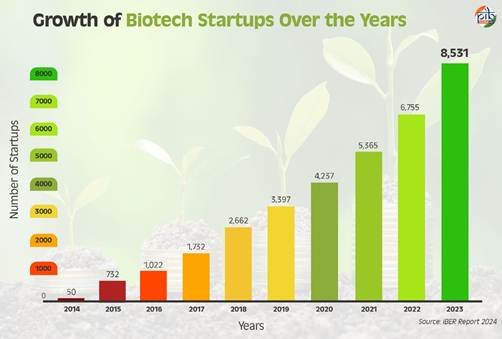
Context India’s biotech sector has surged in the past several years, from a modest count of roughly 500 startups in 2018, the number has soared to over 10,000 in 2025. What is Bioeconomy? The bioeconomy is the use of renewable biological resources to produce food, energy and industrial goods, which supports sustainability and economic growth.
Source Content
Syllabus: GS3/Economy
Context
- India’s biotech sector has surged in the past several years, from a modest count of roughly 500 startups in 2018, the number has soared to over 10,000 in 2025.
What is Bioeconomy?
- The bioeconomy is the use of renewable biological resources to produce food, energy and industrial goods, which supports sustainability and economic growth.
- Innovations like gene editing and bioprinting are driving progress, while integration across sectors strengthens long-term impact.
- By aligning biotechnology with digital tools and circular economy principles, the bioeconomy offers sustainable solutions to environmental challenges and promotes overall societal well-being.
India’s Bioeconomy
- India is among the Top 12 destinations for biotechnology worldwide and 3rd largest destination for biotechnology in Asia Pacific.
- India’s bioeconomy has grown sixteen-fold from $10 billion in 2014 to an impressive $165.7 billion in 2024.
- Contributing 4.25% to the national GDP, the sector has demonstrated a robust compound annual growth rate (CAGR) of 17.9% over the past four years.
- India’s Biotechnology sector is categorised into Biopharmaceuticals, Bio agriculture, Bio IT and Bio Services.
- Future Goals: Target of achieving a $300 billion bioeconomy by 2030.
- India also seeks to lead globally in bio-pharma, including vaccines, diagnostics, and therapeutics.
Concerns
- Fragmentation of Infrastructure: India hosts over 70 incubators, but few have end-to-end facilities such as pilot-scale purification systems, fill-and-finish suites, regulatory affairs support.
- This forces entrepreneurs to operate across cities, duplicating costs and processes.
- Regulatory Complexities: Outdated frameworks for clinical trials, patent laws and product approval.
- Lag behind modern demands (AI, biologics, genomics), delaying market entry and deterring investment.
Government Initiatives and Key Programmes
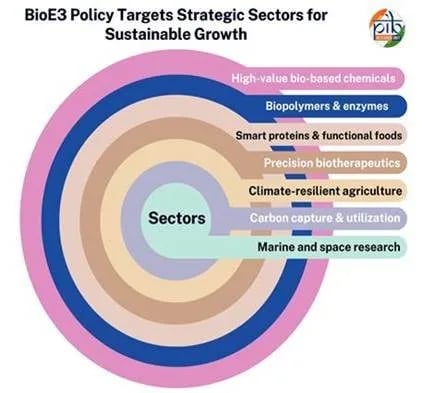
- BioE3 Policy (Biotechnology for Economy, Environment, and Employment): It was approved by the Union Cabinet in 2024, has an ambitious vision to create a $300-billion bioeconomy by 2030.
- National Biopharma Mission: It is a government-approved initiative led by the Department of Biotechnology (DBT) and implemented by BIRAC.
- Aim: To boost India’s capabilities in biopharmaceuticals, vaccines, biosimilars, medical devices, and diagnostics by fostering collaboration between industry and academia.
- Bio-agriculture: Agricultural biotechnology in India is advancing rapidly through innovations in genomics, transgenics, and gene editing under the Department of Biotechnology’s Agriculture Biotechnology programme.
- Climate-Smart Crops: A drought-tolerant, high-yielding chickpea variety SAATVIK (NC 9) has been approved for cultivation.
- Genome-Edited Rice: Loss-of-function mutations in yield-limiting genes have led to improved rice lines like DEP1-edited MTU-1010, showing higher yields.
- Genotyping Arrays: India’s first 90K SNP arrays—IndRA for rice and IndCA for chickpea—enable DNA fingerprinting and variety identification.
- Amaranth Resources: A genomic database, NIRS techniques, and a 64K SNP chip aid nutritional screening and development of anti-obesity amaranth varieties.
- Biocontrol: A nano-formulation from Myrothecium verrucaria offers eco-friendly control of powdery mildew in tomato and grape.
- Kisan-Kavach: An anti-pesticide protective suit enhances farmer safety from toxic exposure.
- Biotech-KISAN (Biotech-Krishi Innovation Science Application Network): Biotech-KISAN is a scientist-farmer partnership programme launched to empower farmers through agricultural innovation and scientific interventions.
- Bioenergy: Ethanol blending has seen a significant rise—from 1.53% in 2014 to 15% in 2024, with a target of 20% blending by 2025.
- Boosting Biotech Innovation Through BIRAC Initiatives: The Biotechnology Industry Research Assistance Council (BIRAC), established by the Department of Biotechnology in 2012, plays a pivotal role in nurturing India’s biotech startup ecosystem.
- With 95 bio-incubation centres set up nationwide, BIRAC supports startups through funding, infrastructure, and mentorship.
Way Ahead
- India’s bioeconomy stands at a defining moment, with its integrated approach to innovation, sustainability, and inclusive development setting a global benchmark.
- The convergence of bio-manufacturing, bio-agriculture, and bioenergy not only strengthens national resilience but also signals India’s strategic intent to lead in the emerging global bioeconomy.
Source: TH
Sources and further reading
- BioE3 Policy (Biotechnology for Economy, Environment, and Employment)nextias.com
- THthehindu.com