
Brief Context
Context Violent youth protests in Ladakh demanding statehood and Sixth Schedule status have led to four deaths and over 30 injuries. Background: From UT Status to Unrest August 2019: Ladakh was separated from Jammu Kashmir and made a Union Territory without a legislature, unlike Jammu Kashmir. Initially, many Ladakhis welcomed the move, hoping for better governance and development.
Source Content
Syllabus: GS2/Governance
Context
- Violent youth protests in Ladakh demanding statehood and Sixth Schedule status have led to four deaths and over 30 injuries.
Background: From UT Status to Unrest
- August 2019: Ladakh was separated from Jammu & Kashmir and made a Union Territory without a legislature, unlike Jammu & Kashmir.
- Initially, many Ladakhis welcomed the move, hoping for better governance and development.
- However, the absence of legislative power and fears of demographic change soon led to disillusionment.
- The Leh Apex Body (LAB) and Kargil Democratic Alliance (KDA) emerged as key voices, representing both Buddhist and Muslim communities across Leh and Kargil.
Key Reasons for the Protests
- Lack of Legislative Power: Ladakhis lost representation in the J&K Assembly and Legislative Council.
- The Ladakh Autonomous Hill Development Councils (LAHDCs) have limited authority, mostly restricted to spending development funds.
- Fear of Demographic and Cultural Erosion: Locals worry that opening Ladakh to outside investment could alter its fragile ecology and cultural identity.
- Large-scale solar and industrial projects are being planned without local consent, raising concerns about land rights and displacement.
- Employment and Land Rights: There is growing demand for a Ladakh Resident Certificate to protect local jobs and land ownership — similar to protections once offered under Article 35A.
Core Demands
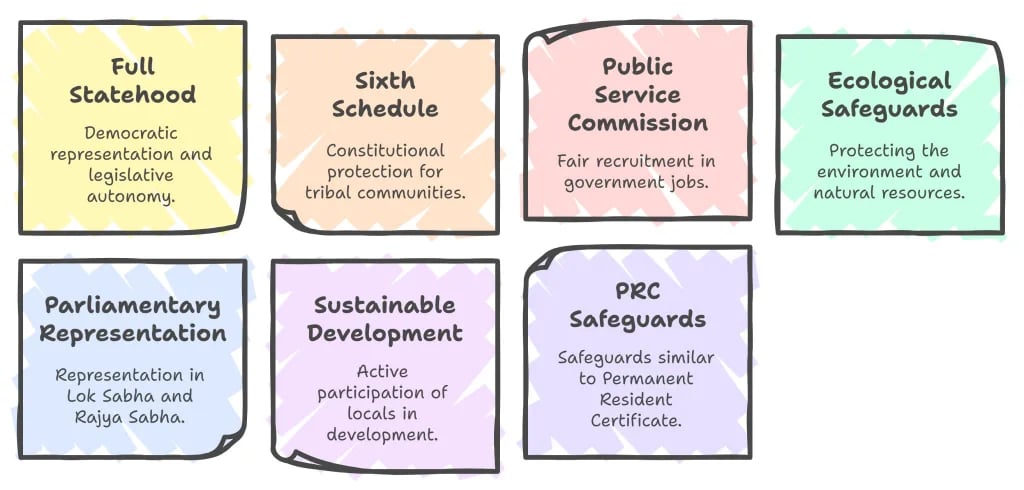
Government Response & Measures
- Dialogue and High-Powered Committees: The Union Home Ministry (MHA) set up a High-Powered Committee (HPC) to engage with protest leaders from the Leh Apex Body (LAB) and Kargil Democratic Alliance (KDA). The committee’s mandate includes:
- Exploring constitutional safeguards for Ladakh;
- Strengthening the LAHDCs of Leh and Kargil;
- Ensuring protection of land, employment, and cultural identity;
- Facilitating inclusive development and fast-track recruitment;
- The National Commission for Scheduled Tribes (NCST), in its 119th meeting, recommended that Ladakh be brought under the Sixth Schedule.
- Ladakh has over 97% of its population belonging to Scheduled Tribes and the need to preserve its agrarian and cultural rights.
- Reservation in Government Jobs: 85% reservation for resident Ladakhis in government employment;
- Of this, 80% reserved for STs;
- Additional Quotas: 4% for residents along the LAC and LoC;
- 1% for SCs; and 10% for EWS;
- Total reservation reaches 95%, among the highest in India.
- Regulatory Amendments:
- Ladakh Reservation (Amendment) Regulation, 2025;
- Ladakh Civil Services Decentralisation and Recruitment (Amendment) Regulation, 2025;
- Ladakh Official Languages Regulation, 2025;
- Ladakh Autonomous Hill Development Councils (Amendment) Regulation, 2025.
- Domicile Criteria: Individuals need to prove 15 years of continuous residence in Ladakh from October 31, 2019 (the day Ladakh became a UT), to qualify as a domicile.
- Children of Central government employees, All India Services officers, and PSU staff posted in Ladakh are eligible under specific conditions;
- Women’s Political Representation: One-third of seats in Ladakh’s Autonomous Hill Development Councils (LAHDCs) reserved for women on a rotational basis.
| Geography of Ladakh – It is a high-altitude cold desert, lying in the rain shadow of the Himalayas. – It is dominated by three major mountain ranges like Zanskar Range, Ladakh Range and Karakoram Range. – Major Mountain Passes: Khardung La and Chang La – Major Rivers: Indus, Nubra, Shyok, and Zanskar – It shares its international borders with China (North & East); Pakistan-occupied Kashmir (Northwest); and Afghanistan. – It is the 2nd largest district in India after Kutch in Gujarat. – It falls under Seismic Zone IV (high earthquake risk). |
Sources and further reading
- statehood and Sixth Schedulenextias.com
- Source: THthehindu.com