
Brief Context
In News Scientists from the Indian Institute of Astrophysics and NASA have made the first-ever spectroscopic observations of a coronal mass ejection (CME) in the visible wavelength range, close to the Sun’s surface using the VELC payload on Aditya-L1. Aditya-L1 It is India’s first space-based solar observatory, designed to study the Sun from Lagrange Point 1, located about 1.5 million km from Earth This position allows uninterrupted observation of solar phenomena without eclipses or occultation.
Source Content
Syllabus: GS3/Space
In News
- Scientists from the Indian Institute of Astrophysics and NASA have made the first-ever spectroscopic observations of a coronal mass ejection (CME) in the visible wavelength range, close to the Sun’s surface using the VELC payload on Aditya-L1.
Aditya-L1
- It is India’s first space-based solar observatory, designed to study the Sun from Lagrange Point 1, located about 1.5 million km from Earth.
- This position allows uninterrupted observation of solar phenomena without eclipses or occultation.
- It launched in September 2023 to enhance understanding of solar dynamics, including coronal mass ejections (CMEs), solar flares, and their impact on space weather — crucial for satellite operations, communications, and power grids on Earth.
- The mission carries seven indigenously developed payloads, five by ISRO and two in collaboration with Indian academic institutions.
- These instruments are designed to observe the photosphere, chromosphere, and corona of the Sun,Solar emissions and magnetic field variations and Solar wind and energetic particle fluxes.
| Lagrange Points – Lagrange Points are positions in space where the gravitational forces of two massive bodies (like the Sun and Earth) and the centripetal force of a smaller object (like a spacecraft) balance each other. – This allows the smaller object to remain relatively stable with respect to the two larger bodies. – There are five such points (L1–L5) in the Sun-Earth system. 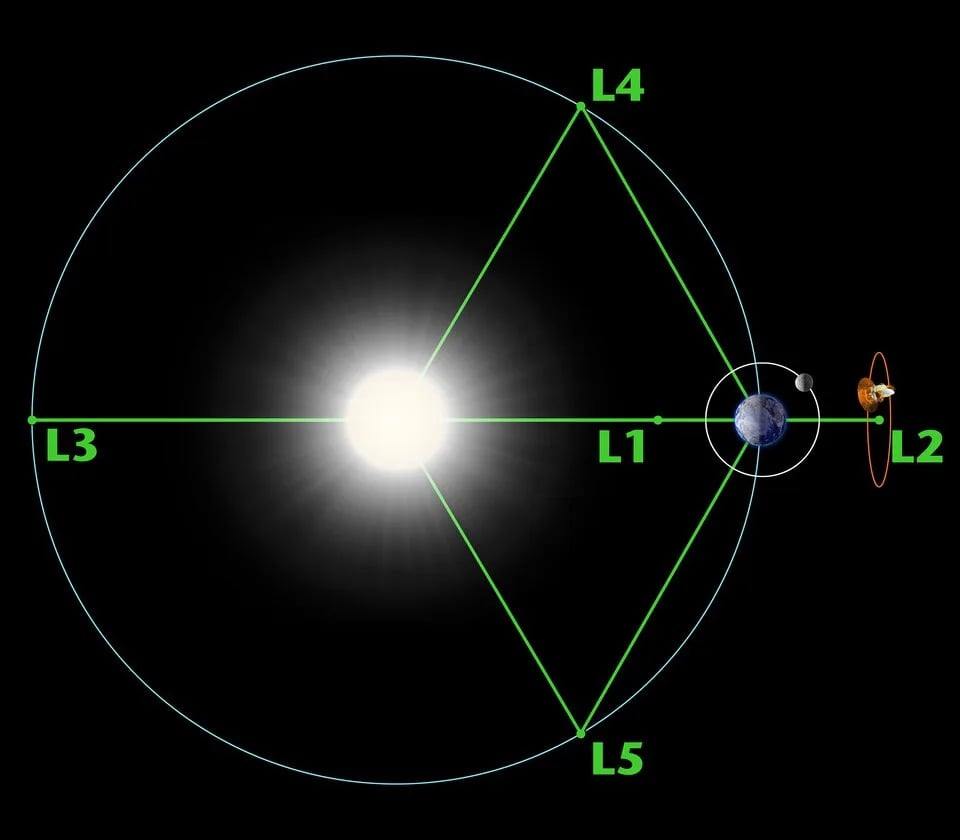 Halo Orbit – A three-dimensional periodic orbit around a Lagrange point. Unlike a simple circular orbit, it forms a loop-like path (halo) around L1. – It helps spacecraft avoid direct shadowing by Earth or Moon while maintaining a stable position with minimal fuel consumption. |
Strategic Significance
- Aditya-L1 will provide continuous solar monitoring, helping predict space weather events and their terrestrial impacts.
- It supports global solar research and complements missions like NASA’s Parker Solar Probe and ESA’s Solar Orbiter.
- It showcases India’s growing capability in observatory-class space science.
- It aligns with India’s broader space ambitions, including the upcoming Gaganyaan human spaceflight mission and interplanetary exploration.
Sources:TH