
Brief Context
Context Recently experts have advocated for India to consider catastrophe bonds (cat bonds) as a financial instrument to manage disaster risk and post-disaster reconstruction costs. What is a Cat Bond? Cat bonds are a unique hybrid insurance-cum-debt financial product that transforms insurance cover into a tradable security.
Source Content
Syllabus: GS3/ Economy; Disaster Management
Context
- Recently experts have advocated for India to consider catastrophe bonds (cat bonds) as a financial instrument to manage disaster risk and post-disaster reconstruction costs.
What is a Cat Bond?
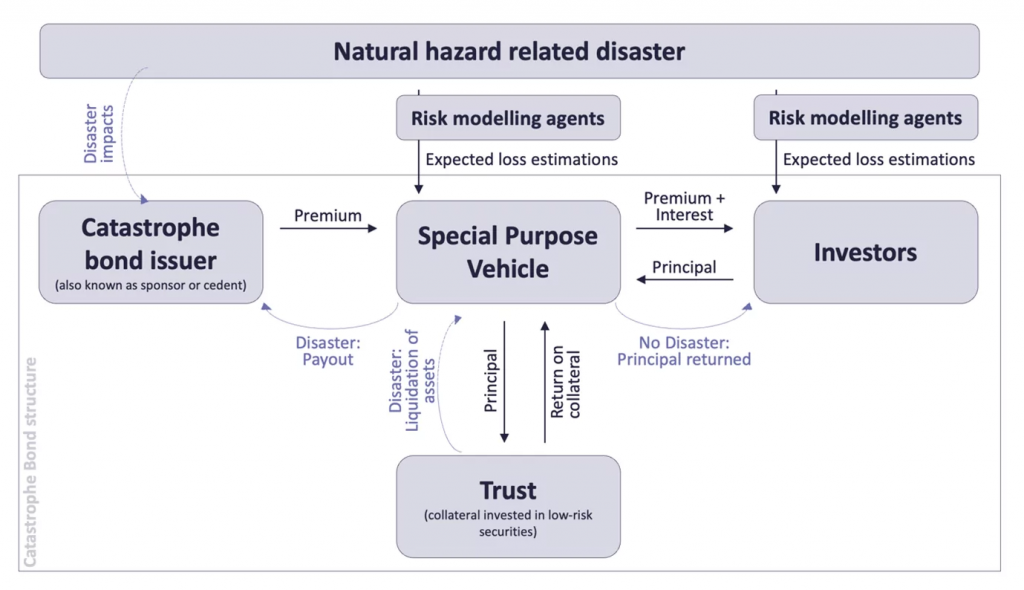
- Cat bonds are a unique hybrid insurance-cum-debt financial product that transforms insurance cover into a tradable security.
- These are high-yield debt instruments, issued by a sponsoring entity (like a government), through intermediaries such as the World Bank or ADB, and bought by investors.
- If a specified disaster occurs, the investor may lose part or all of their principal, which is then used for relief and reconstruction.
- If no disaster occurs during the bond period, investors earn attractive coupon payments.
- When a cat bond is created, a Special Purpose Vehicle (SPV) is also set up. This SPV is like a temporary company made just for handling that bond. It makes sure that:
- The money is safe and not mixed with other government or company funds.
- Investors are protected from fraud or misuse.
Advantages of Cat Bonds
- Risk Diversification: As noted by Nobel Laureate Harry Markowitz, adding cat bonds helps diversify investor portfolios since disaster risk is uncorrelated with traditional financial markets.
- Faster Payouts: Unlike conventional insurance claims which may take months to settle, cat bonds disburse funds quickly after a trigger event, enabling immediate disaster response.
- Reduced Burden on Governments: They provide pre-arranged financing, protecting government budgets from sudden shocks due to disaster recovery expenses.
- Wider Capital Base: These instruments tap into global financial markets, going beyond traditional reinsurance capacities.
- Promotion of Mitigation Efforts: Issuers with stronger disaster preparedness and mitigation policies can avail lower premiums, promoting risk-reducing behaviours.
Limitations of Cat Bond
- Trigger Threshold Rigidity: If the disaster is slightly below the predefined threshold (e.g., a 6.5M earthquake when the bond requires 6.6M), no payout is triggered, even if damages are severe.
- Opportunity Cost: If no disaster occurs, the premium paid may appear wasteful, especially in resource-scarce settings.
- Design Complexity: A poorly designed bond may exclude many probable risk scenarios, rendering it ineffective.
- High Premiums for High-Risk Regions: Hazard-prone regions may attract higher premiums, reducing cost-effectiveness unless supported by global intermediaries.
Potential for Cat Bonds in India
- Disaster Exposure: India is one of the most disaster-prone countries globally, facing regular cyclones, floods, landslides, and earthquakes.
- Low Insurance Penetration: Disaster risk insurance remains poorly developed, leaving most individual assets and livelihoods uninsured.
- Government Funding: India allocates ₹1.8 billion annually (since FY21–22) for disaster mitigation and capacity building, signalling readiness for proactive risk management.
Source: TH
Sources and further reading
- financial marketsnextias.com
- landslidesnextias.com
- earthquakesnextias.com
- THthehindu.com