
Brief Context
Context According to a study titled ‘Ocean Heat Content Sets Another Record in 2025’, found that the oceans absorbed more heat in 2025 than in any year since modern measurements began in the 1960s. Key Findings of Study Record-Breaking Ocean Heat Content (OHC): The Earth’s oceans absorbed 23 Zettajoules (ZJ) of additional heat in 2025, surpassing all previous records since the 1960s. It marks a 44% increase compared to 2024, when oceans absorbed 16 ZJ.
Source Content
Syllabus: GS3/Environment & Climate Change
Context
- According to a study titled ‘Ocean Heat Content Sets Another Record in 2025’, found that the oceans absorbed more heat in 2025 than in any year since modern measurements began in the 1960s.
- It focused on the top 2,000 meters of the ocean, where most heat is stored.
Key Findings of Study
- Record-Breaking Ocean Heat Content (OHC): The Earth’s oceans absorbed 23 Zettajoules (ZJ) of additional heat in 2025, surpassing all previous records since the 1960s.
- It marks a 44% increase compared to 2024, when oceans absorbed 16 ZJ.
- Rising Global Sea-Surface Temperatures (SSTs): Global average SSTs in 2025 were the third highest on record, roughly 0.5°C above the 1981–2010 baseline.
- The South Atlantic, North Pacific, and Southern Ocean were identified as the fastest-warming regions.
- Oceans Absorb 90% of Anthropogenic Heat: Nearly 90% of the excess heat trapped by greenhouse gases (GHGs) since the industrial era has been absorbed by the oceans.
- This has led to steady, long-term warming even during years when atmospheric temperature rise slows temporarily.
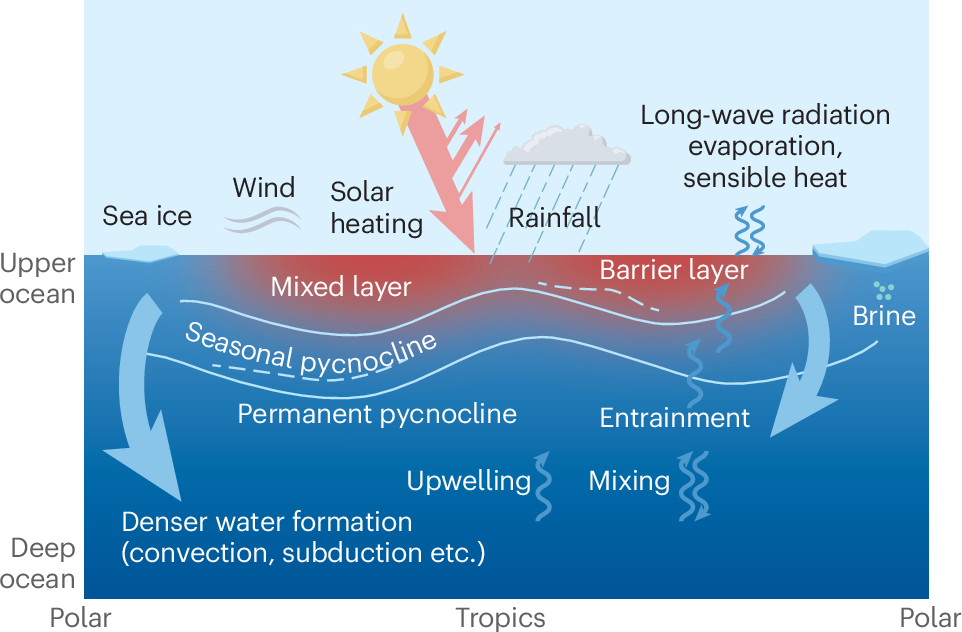
- Increased Ocean Stratification: Rising heat content has intensified ocean stratification like separating warm, light, nutrient-poor surface waters from cooler, denser, nutrient-rich deep waters.
- It reduces vertical mixing, meaning:
- Less CO₂ absorbed by oceans.
- Oxygen depletion in deeper waters.
- Nutrient scarcity for marine life near the surface.
- It reduces vertical mixing, meaning:
- Threats to Marine Ecosystems: Stratification and warming together threaten phytoplankton populations, which form the base of marine food webs.
- Decline in phytoplankton affects zooplankton, fish, crustaceans, and corals, increasing the risk of ecosystem collapse.
- Marine Heat Waves (MHWs) Intensifying: Marine heat waves (defined as ocean regions 3–4°C above average for ≥5 days) are becoming more frequent, longer, and more intense.
- According to the IPCC (2021), MHW frequency has doubled between 1982 and 2016.
- MHWs drive coral bleaching, reduce coral reproduction, and alter fish migration patterns.
- Stronger and More Destructive Storms: Warmer oceans are fueling more powerful tropical storms, cyclones, and hurricanes.
- Increased evaporation and heat transfer intensify storms, leading to stronger winds, heavier rainfall, and worse flooding upon landfall.
| Oceans Warming – Ocean warming is primarily driven by human-induced climate change, with greenhouse gas emissions, thermal expansion, and altered ocean-atmosphere interactions. Causes of Ocean Warming – Increased GHGs concentrations, especially carbon dioxide (CO₂), methane (CH₄), and nitrous oxide (N₂O), trapping heat in the Earth’s atmosphere. Impact on Marine Life and Ecosystems – Coral bleaching is increasing, with up to 70–90% of coral reefs expected to be lost if global warming exceeds 1.5°C. Ocean Warming and Climate Feedback Loops – As water warms, it expands (thermal expansion), contributing to sea level rise, alters the density and circulation of ocean currents. Regional Focus: Indian Ocean -Data from the Ministry of Earth Sciences (MoES) and INCOIS show that: Mitigation and Global Action – The UN Decade of Ocean Science for Sustainable Development (2021–2030) emphasizes: India’s National Centre for Coastal Research (NCCR) and MoES have initiated long-term ocean observation programs under the Deep Ocean Mission, aimed at understanding and mitigating ocean warming effects. |
Sources and further reading
- Source: IEindianexpress.com