
Brief Context
The third report on the Demands for Grants (2025-26) of the Ministry of Railways emphasizes several areas for improvement in the Indian Railways, focusing on technological advancements, capacity expansion, and safety enhancement.
Source Content
Syllabus :GS3/Economy
In News
- The third report on the “Demands for Grants (2025-26)” of the Ministry of Railways emphasizes several areas for improvement in the Indian Railways, focusing on technological advancements, capacity expansion, and safety enhancement.
| Do you know ? – Indian Railways is managed by the Ministry of Railways through the Railway Board. – The Railways’ expenditure is funded by: Internal revenue (mainly from goods and passenger earnings) 1. Budgetary support from the central government, 2. Extra-budgetary resources (including borrowings, institutional financing, and public-private partnerships). 3. Working expenses like salaries, pensions, and asset maintenance are covered by internal resources. 4. Capital expenditure is funded by government grants and extra-budgetary resources. |
Preset Status
- Indian Railways is undergoing a major transformation to provide faster, safer, and world-class travel experiences to billions of Indians at a nominal cost.
- As part of this effort, the railway has spent 76% of its budget for the current fiscal year, with a focus on capacity augmentation, including the introduction of 136 Vande Bharat trains, near-total electrification of broad gauge lines, and infrastructure development such as new tracks and gauge conversion.
- These investments are enhancing travel speed, safety, and comfort.
Budget Overview
- Railways’ internal revenue for 2025-26 is estimated to be Rs 3,02,100 crore. This an increase of 8.3% over the revised estimate for 2024-25.
- In 2025-26, 99.8% of revenue is estimated to be raised from traffic operations (Rs 3,01,400 crore).
- The total revenue expenditure in 2025-26 is estimated at Rs 2,99,059 crore, an increase of 7.7% over the revised estimate of 2024-25.
- In 2025-26, capital expenditure is estimated at Rs 2,65,200 crore, same as the revised estimate for 2024-25.
Issues
- The National Rail Plan, 2020 (NRP) highlighted underinvestment in capacity, leading to congestion on high-demand routes and low average speeds.
- Indian Railways faces competition from the road sector in attracting freight due to better first and last-mile connectivity.
- Railway finances are constrained, as revenue expenditure has averaged 99% of internal revenue in the last decade, limiting investment in capital works.
- Additionally, between 2000-01 and 2023-24, 3,953 consequential train accidents occurred, including 48 in 2022-23 and 40 in 2023-24, involving collisions, fires, and derailments.
Recent recommendations
- Technology & Safety: The report stresses the importance of advancing technology, including the execution of automatic train protection systems like Kavach.
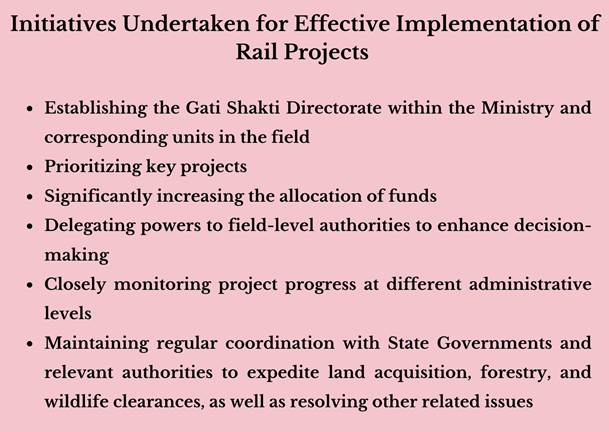
- Infrastructure Development: Prioritizing capital expenditure for infrastructure development, modernisation, and asset replacement is recommended to ensure timely completion of projects and avoid cost overruns.
- Revenue Optimisation: Suggestions for optimising operating expenses, adopting energy-efficient technologies, and exploring alternative revenue avenues to boost passenger and freight revenues are made.
- Staff Welfare: The Ministry is urged to focus on staff welfare initiatives to improve morale and productivity.
- Internal Resource Mobilisation: The Committee advises the Ministry to explore new ways to increase internal earnings and reduce dependence on government budget allocations by leveraging private sector expertise and market borrowing.
- Doubling of Railway Lines: While the financial utilization stands at 74%, physical progress on doubling railway lines is only 39%, with the Committee urging Railways to address obstacles hindering progress.
- Manned Level Crossings & Production Targets: The Committee highlights consistent shortfalls in closing manned level crossings and meeting production targets for coaches and wagons, recommending an increase in manufacturing capacity.
- Station Redevelopment: Improvements in crowd management and better planning for station redevelopment are urged to prevent incidents and improve efficiency.
- Freight Efficiency: A market-driven approach is recommended to enhance freight traffic, particularly through Dedicated Freight Corridors (DFCs).
- Mumbai-Ahmedabad High-Speed Rail Project: The Committee calls for expedited finalisation of contract packages and timely completion of the project, along with addressing construction challenges and delays to avoid cost overruns.
- Indigenous Manufacturing: Expanding the indigenous manufacturing of Shinkansen technology components under the Make-in-India initiative is advised to support the long-term sustainability of high-speed rail operations.
Conclusion
- The Indian Railways is undergoing a transformative phase, marked by significant investments and modernization efforts to enhance its infrastructure, safety, and passenger experience.
- Key initiatives, such as the Amrit Bharat Station Scheme, modernization of locomotives and coaching stock, and the implementation of advanced safety measures, are crucial steps towards achieving this vision.
- These comprehensive measures are expected to not only boost the efficiency and safety of train operations but also support India’s broader economic growth and connectivity goals.
Source :TH