
Brief Context
Context A recent study identifies mechanical fatigue of the lithium metal anode, rather than current density alone, as the key cause behind dendrite-induced short circuits and failure of Solid-State Batteries (SSBs). Applications of Solid-State Batteries Electric Vehicles (EVs): Toyota and BMW are developing SSB-powered EVs with extended range and rapid charging. Consumer Electronics: Companies like Apple and Samsung are investing in SSBs for safer and longer-lasting smartphones and laptops.
Source Content
Syllabus: GS3/Science and Technology
Context
- A recent study identifies mechanical fatigue of the lithium metal anode, rather than current density alone, as the key cause behind dendrite-induced short circuits and failure of Solid-State Batteries (SSBs).
What are Solid-State Batteries (SSBs)?
- (SSB) is an advanced type of battery that uses a solid electrolyte instead of the liquid or gel-like electrolyte found in conventional lithium-ion batteries.
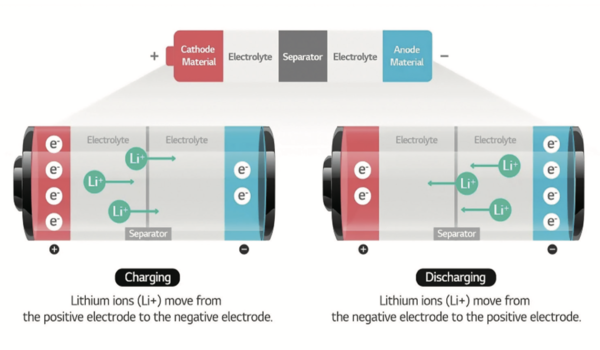
- Working Mechanism:
- Charging Phase: Lithium ions move from the cathode to the anode through the solid electrolyte, storing energy.
- Discharging Phase: Lithium ions travel back from the anode to the cathode, generating an electric current that powers devices or vehicles.
Difference between Conventional Li-ion Batteries and SSBs
| Feature | Traditional Li-ion Battery | Solid-State Battery |
| Electrolyte | Liquid (flammable) | Solid (non-flammable) |
| Energy Density | Moderate | Higher (up to 2x) |
| Safety | Risk of leakage and fire | Safer due to solid electrolyte |
| Charging Speed | Limited | Faster potential |
| Thermal Stability | Lower | Higher |
Challenges in Solid-State Batteries (SSBs)
- Lithium Dendrite Formation: Dendrites are hair-like metallic lithium structures that grow on the anode during repeated charge cycles.
- These structures form when lithium ions (Li⁺) unevenly deposit during charging. These dendrites can:
- Pierce the solid electrolyte,
- Reach the cathode, and
- Cause a short circuit, rendering the battery unsafe and unusable.
- Even at low current densities, dendrites can form due to cyclic mechanical fatigue of the lithium metal anode.
- The Coffin-Manson law of material fatigue, a well-known principle in materials science, was found applicable to lithium metal degradation.
Applications of Solid-State Batteries
- Electric Vehicles (EVs): Toyota and BMW are developing SSB-powered EVs with extended range and rapid charging.
- Consumer Electronics: Companies like Apple and Samsung are investing in SSBs for safer and longer-lasting smartphones and laptops.
- Grid Storage: Tesla and other energy giants are investigating SSBs for renewable energy storage solutions.
Source: TH
Sources and further reading
- THthehindu.com