
Brief Context
Context India is facing both a responsibility and a historic opportunity — to repay the debt owed to regions that fueled India’s food security, and to reimagine agriculture for a sustainable future. About the Green Revolution The term ‘Green Revolution’ was coined by William S. Gaud, then Administrator of the United States Agency for International Development (USAID), in 1968.
Source Content
Syllabus: GS3/Agriculture
Context
- India is facing both a responsibility and a historic opportunity — to repay the debt owed to regions that fueled India’s food security, and to reimagine agriculture for a sustainable future.
About the Green Revolution
- The term ‘Green Revolution’ was coined by William S. Gaud, then Administrator of the United States Agency for International Development (USAID), in 1968.
- It turned a famine-prone nation into a food-secure one, ushering in self-sufficiency in grain production and empowering millions of farmers.
- In India, the Green Revolution benefited Punjab, Haryana, and western Uttar Pradesh with its focus on high-yielding rice and wheat varieties, irrigation expansion, and intensive chemical input.
India’s Agricultural Gains
- India’s Green Revolution was catalyzed by International Maize and Wheat Improvement Center (CIMMYT) and IRRI germplasm. Varieties like Kalyan Sona and Sonalika (1967–68) came from CIMMYT breeding lines.
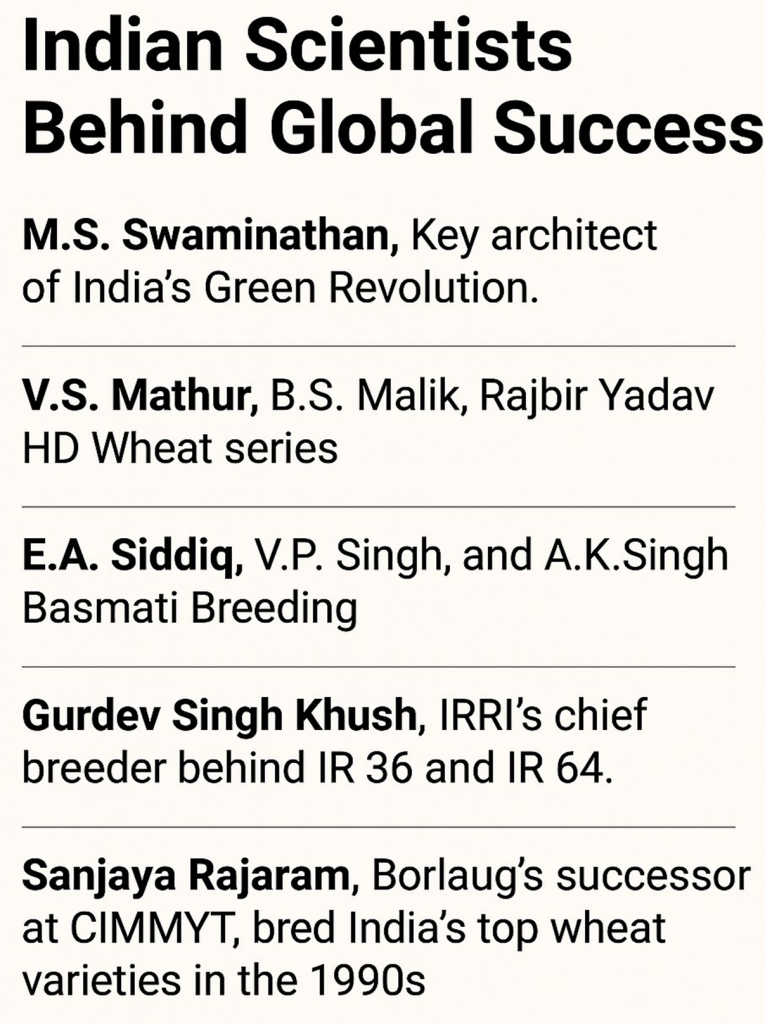
- Later, Indian institutions like the Indian Agricultural Research Institute (IARI) developed indigenous varieties pushing yields to 7 tonnes/hectare.
- In rice, IARI and regional institutes released iconic varieties like Swarna (1982), Samba Mahsuri (1986), and Pusa Basmati 1121 (2003).
- In 2024–25, India exported 6.1 million tonnes of basmati rice worth $5.94 billion, over 90% from IARI-developed varieties.
| Do You Know? – International Maize and Wheat Improvement Center (CIMMYT) bred semi-dwarf wheat varieties like Lerma Rojo 64A, Sonora 63, and Mayo 64, which were first introduced in India in 1964-65. – CIMMYT was funded heavily by the United States Agency For International Development (USAID), and closely associated with Norman Borlaug. 1. USAID provided $83 million of its $211 million grant revenue in 2024. 2. CIMMYT has lost a major funder, with the Trump administration shutting down USAID. – Norman Borlaug’s wheat enabled Indian farmers to achieve 4–4.5 tonnes/hectare, up from 1–1.5 tonnes. – International Rice Research Institute (IRRI)’s rice varieties raised yields from 1–3 tonnes to 4.5 – 10 tonnes/hectare, reducing crop duration to 110–130 days. |
Green Revolution: Legacy & and Its Costs
- Continued Reliance on Global Research: As of 2024–25, 6 of the top 10 wheat varieties sown over 20 million hectares in India were directly derived from CIMMYT material.
- HD 2967 remains the only recent major indigenous variety.
- While northern states thrived, others — especially eastern and central India — remained underdeveloped. The excessive focus on procurement, subsidies, and irrigation for a narrow set of crops led to:
- Soil nutrient depletion and water table collapse.
- Stifled crop diversification and ecological imbalance.
- Farmer dependency on input-intensive monocultures.
Policy Levers to Address the Imbalance
- Decentralized Procurement: Expanding procurement beyond wheat and rice to include pulses, millets, and oilseeds from underserved regions like central India and the Northeast.
- Agroecological Transition: Supporting states to adopt regenerative agricultural practices and reduce chemical dependency.
- Water-Smart Farming: Incentivizing crops suited to local climates and water availability, rather than forcing uniform choices.
- Income Diversification: Promoting agro-processing, farm cooperatives, and access to rural credit to give farmers alternative revenue streams.
- Regional Equity: Diversifying procurement policies to include pulses, oilseeds, and millets from underrepresented regions.
India’s Opportunity and Responsibility
- Despite its gains, India contributed just $0.8 million to CIMMYT and $18.3 million to IRRI in 2024. According to Rajendra Singh Paroda, former DG of ICAR, India should fund strategic and collaborative research in:
- Heat and drought tolerance;
- Nitrogen use efficiency;
- Gene editing;
- Artificial intelligence in breeding
- Recent initiatives like the International Year of Millets, ‘Bringing Green Revolution in Eastern India’ and the push for regenerative farming offer encouraging signals — but scale and sincerity are key.