
Brief Context
Context The Committee constituted for the Framework on Repairability Index (RI) in Mobile and Electronic Sector has submitted its Report to the Department of Consumer Affairs (DoCA), Government of India. Background India ranks as the third-largest producer of electronic waste globally, following China and the United States. The surge in electronic consumption, coupled with limited repair options, has contributed significantly to this issue.
Source Content
Syllabus: GS3/ Economy
Context
- The Committee constituted for the Framework on Repairability Index (RI) in Mobile and Electronic Sector has submitted its Report to the Department of Consumer Affairs (DoCA), Government of India.
Background
- India ranks as the third-largest producer of electronic waste globally, following China and the United States.
- The surge in electronic consumption, coupled with limited repair options, has contributed significantly to this issue.
- Between 2022 and 2025, consumer complaints related to mobile phones and tablets increased from 19,057 to 22,864, underscoring the need for improved repair accessibility and transparency in post-sale services.
- In September 2024, the DoCA established a committee under the chairmanship of Bharat Khera to develop a framework for the Repairability Index.
Key Recommendations of the Committee
- Self-Declared Repairability Scores: Original Equipment Manufacturers (OEMs) should self-assess and declare the repairability of their products based on standardized criteria, minimizing additional compliance burdens.
- Display of RI: The Repairability Index should be prominently displayed at points of sale, on e-commerce platforms, and via QR codes on product packaging to enable consumers to make informed choices.
- Scoring Parameters: Repairability is assessed on six core parameters.
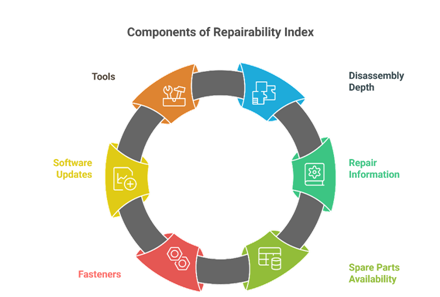
- Priority Components: The framework should focus on components prone to frequent failures and critical to device functionality, including batteries, display assemblies, microphones, and speakers.
- Stakeholder Engagement: The committee engaged with a wide array of stakeholders, including manufacturers, industry associations, consumer advocacy groups, and government representatives, to ensure a comprehensive and inclusive framework.
Significance of the Repairability Index
- Reduction in Electronic Waste: Enhancing repair options will extend product lifespans, thereby reducing the volume of e-waste generated.
- Circular Economy: The RI supports the principles of a circular economy by encouraging the reuse and repair of products, reducing the need for new resource extraction.
- Local Repair Industries: Improved access to repair information and parts will bolster local repair businesses, contributing to economic growth and job creation.
Global Scenario in Right to Repair
- United Kingdom: Right to Repair Regulations 2021, covers home appliances (e.g., fridges, washers, TVs).
- Manufacturers must supply spare parts for up to 10 years.
- France: Introduced a mandatory Repairability Index on five categories: smartphones, laptops, washing machines, TVs, and lawnmowers.
| Right to Repair Portal India – Launched in 2022, the Right to Repair Portal serves as a centralized platform providing consumers with information on repair services across four sectors: 1. Farming Equipment 2. Mobiles and Electronics 3. Consumer Durables 4. Automobile Equipment |
Challenges
- Technical Complexity: Modern electronic devices often feature compact and intricate designs, making repairs more challenging and necessitating specialized tools.
- Manufacturer Resistance: Some OEMs express concerns over intellectual property rights and the potential impact on product security and performance.
Concluding remarks
- The introduction of the Repairability Index in India’s mobile and electronics sector marks a significant step towards sustainable consumption and consumer empowerment.
- By promoting transparency and facilitating repairs, the initiative has the potential to reduce electronic waste, stimulate local economies, and align with global sustainability goals.
Source: PIB
Sources and further reading
- PIBpib.gov.in