
Brief Context
At the 19th edition of the Ramnath Goenka Awards for Excellence in Journalism awards ceremony, President Droupadi Murmu emphasized the critical role of journalism in sustaining democracy.
Source Content
Syllabus: GS2/Fundamental Rights; Government Policies & Interventions
Context
- At the 19th edition of the Ramnath Goenka Awards for Excellence in Journalism awards ceremony, President Droupadi Murmu emphasized the critical role of journalism in sustaining democracy.
Journalism in Democracy
- Journalism is often referred to as the ‘Fourth Estate’, as it acts as a watchdog, ensuring transparency, holding power accountable, and providing citizens with the information necessary to make informed decisions.
- In a democracy, the free flow of reliable information strengthens public discourse, enabling active citizen participation.
Historical Significance of Journalism
- Colonial Era & Early Restrictions: The British government enacted laws such as the Vernacular Press Act (1878) to curb nationalist sentiments.
- Newspapers such as Kesari (edited by Bal Gangadhar Tilak), Bande Mataram and Amrita Bazar Patrika played a crucial role in mobilizing public opinion, often facing suppression.
- In India, the press has been instrumental in:
- Exposing corruption: Investigative journalism has uncovered scandals like the Bofors scam, the 2G spectrum case, and the Vyapam scam.
- Framing Legislations: Newspapers and TV debates have influenced key policies and legal reforms, such as the Right to Information (RTI) Act.
- Ensuring electoral integrity: Media coverage of elections educates voters about candidates, policies, and political manifestos.
Functions of Journalism in a Democracy
- Providing Accurate and Timely Information: A well-functioning democracy depends on an informed electorate.
- Journalists gather, verify, and disseminate news about governance, policies, and social issues, enabling citizens to make knowledgeable choices.
- Acting as a Watchdog: The media plays a crucial role in holding governments, corporations, and institutions accountable.
- Investigative journalism helps expose corruption, human rights violations, and abuses of power.
- Facilitating Public Debate and Opinion Formation: Through editorials, debates, and opinion pieces, journalism provides a platform for diverse viewpoints, fostering a culture of discussion and dissent—both essential for a healthy democracy.
- Educating Citizens: Beyond news, journalism provides critical analysis of economic policies, health issues, and global affairs, enabling people to understand complex topics affecting their lives.
- Defending Press Freedom and Human Rights: A free press is the foundation of any democracy. Independent journalism ensures that governments do not suppress dissenting voices, thus preserving democratic ideals.
Challenges in the Modern Journalism Landscape
- Fake News and Misinformation: With the rise of social media, unverified and misleading information spreads rapidly, often influencing public opinion and electoral outcomes.
- Political and Corporate Influence: Media houses often face pressure from political parties and corporate entities, leading to biased reporting. This undermines journalistic integrity and affects public trust.
- Attacks on Press Freedom: Journalists worldwide face censorship, legal threats, and physical violence. In India, reports of intimidation and arrests under sedition laws have raised concerns about declining press freedom.
- Financial Sustainability: The transition to digital media has disrupted traditional revenue models, making it difficult for independent news organizations to survive without corporate or political backing.
Key Legislations Strengthening Journalism in India
- Press Council Act, 1978: It established the Press Council of India to maintain journalistic ethics.
- Acts as a watchdog against media misconduct but has no punitive powers.
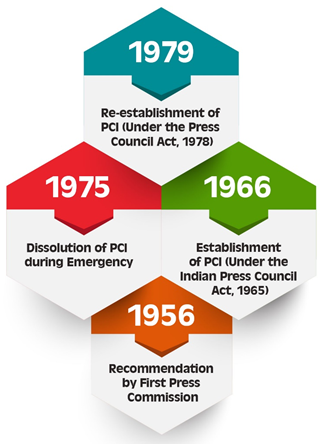
- Right to Information (RTI) Act, 2005: Enables journalists to access government records and promote transparency.
- Used extensively for investigative journalism.
- Whistle Blowers Protection Act, 2014: Provides protection to individuals (including journalists) who expose corruption.
- Cable Television Networks (Regulation) Act, 1995: Regulates content broadcast on TV channels to ensure responsible reporting.
- Information Technology (Intermediary Guidelines and Digital Media Ethics Code) Rules, 2021: Introduces content regulation for digital news media.
- Mandates grievance redressal mechanisms.
- Defamation Laws (Indian Penal Code Sections 499 & 500): Often misused to suppress press freedom but also ensures accountability.
Supreme Court Observations on Journalism in India
- Romesh Thappar vs State of Madras (1950): Affirmed that freedom of the press is part of free speech under Article 19(1)(a).
- However, this right is subject to reasonable restrictions under Article 19(2), allowing the government to impose limitations in cases of national security, defamation, or public order concerns.
- Bennett Coleman & Co. vs Union of India (1973): Struck down government control over newsprint, reinforcing media independence.
- Indian Express Newspapers vs Union of India (1985): Ruled that imposing excessive taxes on newspapers curbs press freedom.
- Sahara India Real Estate Corp vs SEBI (2012): Allowed prior restraints on media reports only in cases of “real and substantial” risk to justice.
- Arnab Ranjan Goswami vs Union of India (2020): Highlighted that press freedom cannot be curtailed arbitrarily, but media must act responsibly.
- Anuradha Bhasin vs Union of India (2020): Stressed that shutting down the internet curbs journalism and violates free speech.
Way Forward: Strengthening Journalism in India
- Legal Reforms and Press Freedom Protections:
- Strengthening the Press Council of India to act as a more effective watchdog.
- Implementing laws to safeguard journalists from legal harassment (e.g., defamation, sedition laws).
- Preventing arbitrary bans on news content and ensuring fair regulations on digital journalism.
- Media Literacy & Ethics Training:
- Encouraging ethical journalism through training programs.
- Promoting fact-checking initiatives to counter misinformation.
- Strengthening self-regulation bodies like the News Broadcasters & Digital Association (NBDA).
- Financial Independence & Sustainability:
- Encouraging independent journalism through grants and subsidies.
- Reducing dependence on government and corporate advertisements.
- Introducing alternative revenue models (e.g., subscription-based journalism).
- Digital Transformation & Cybersecurity:
- Expanding digital access for small and regional news platforms.
- Implementing cybersecurity measures to protect journalists from online threats.
- Enhancing protection against surveillance and data breaches.