
The WHO Report on the Global Tobacco Epidemic 2025 is the tenth edition of the World Health Organization’s assessment of national tobacco-control policies. Published on 23 June 2025, it tracks progress since the launch of the MPOWER package and focuses particularly on warning people about the dangers of tobacco through package labels and mass-media campaigns.
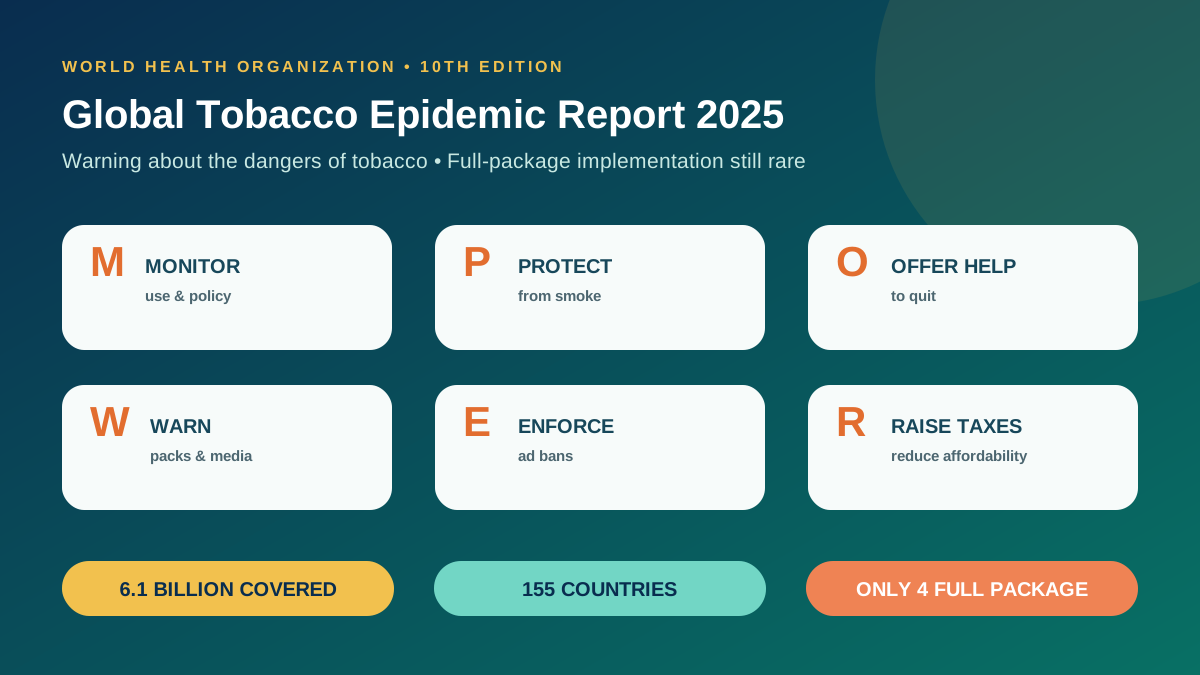
The headline finding is both encouraging and incomplete: 6.1 billion people—about three-quarters of the global population—are protected by at least one MPOWER measure implemented at WHO best-practice level. However, only four countries had reached the best-practice level for the complete package, while 40 countries had not reached it for any MPOWER measure.
What is the WHO global tobacco epidemic report?
The biennial report assesses whether countries have adopted major tobacco-control policies and how closely those policies match WHO’s best-practice criteria. The 2025 edition covers laws and programmes in force at the cut-off date used by WHO; it is a policy-implementation report, not a league table of deaths or a forecast of when tobacco use will end.
It is linked to the WHO Framework Convention on Tobacco Control (WHO FCTC), the first treaty negotiated under WHO. The treaty creates legal obligations for its Parties. MPOWER, introduced in 2008, is a technical package that helps governments apply key demand-reduction measures. The two should not be confused: FCTC is the treaty; MPOWER is an implementation toolkit.
What does MPOWER stand for?
| Letter | Policy | Purpose |
|---|---|---|
| M | Monitor tobacco use and prevention policies | Generate reliable prevalence and policy data |
| P | Protect people from tobacco smoke | Create completely smoke-free public and work environments |
| O | Offer help to quit tobacco use | Provide accessible cessation advice and treatment |
| W | Warn about the dangers of tobacco | Use strong pack warnings and effective mass-media campaigns |
| E | Enforce bans on advertising, promotion and sponsorship | Reduce industry marketing and youth exposure |
| R | Raise taxes on tobacco | Reduce affordability and consumption |
The six measures work as a package. Warnings inform people, taxes change price, smoke-free laws protect non-users, advertising bans reduce recruitment, cessation services support users and monitoring shows whether policy is working.
Key findings of the 2025 report
| Indicator | WHO finding | Meaning |
|---|---|---|
| People covered by at least one best-practice measure | 6.1 billion | Coverage expanded from about 1 billion in 2007 |
| Countries with at least one best-practice measure | 155 | Progress is geographically widespread |
| Countries implementing full MPOWER package | 4 | Brazil, Mauritius, the Netherlands and Türkiye |
| Countries one measure away from full package | 7 | Comprehensive implementation remains uncommon |
| Countries with no best-practice MPOWER measure | 40 | Large policy gaps persist |
| Best-practice graphic cigarette warnings | 110 countries | About 5 billion people, or 62% of the world population, covered |
Graphic warnings showed the largest expansion among MPOWER measures. In 2007, only nine countries covering fewer than 400 million people had best-practice warnings on cigarette packs. By 2024, 110 countries had them. Six countries moved to the highest implementation level between the 2022 and 2024 assessment points, extending protection to another 412 million people.
Why the report focuses on warnings
A tobacco package is repeatedly seen by the user and by people nearby. A large, rotating pictorial warning can:
- communicate disease risks without requiring high literacy;
- reduce the promotional value of packaging;
- increase thinking about quitting;
- discourage initiation, especially among young people; and
- display a quitline or other route to treatment.
Best practice is not achieved by printing any small warning. WHO evaluates features such as warning size, pictures, location, rotation and absence of misleading information. The 2025 report also highlights a gap: countries may regulate cigarettes strongly while leaving smokeless tobacco, heated products, e-cigarettes or nicotine pouches with weaker or inconsistent warnings.
Why mass-media campaigns still matter
Package warnings reach purchasers, but media campaigns can reach the whole population and explain harms from smoking, smokeless tobacco and second-hand exposure. Effective campaigns need evidence-tested messages, broad reach, sufficient frequency and evaluation. One-off observance-day publicity is not equivalent to a sustained campaign.
Digital platforms create a new challenge. Tobacco and nicotine promotion can move through influencers, entertainment, brand stretching and cross-border online content. Enforcement therefore requires platform accountability and monitoring, not only rules for newspapers and television.
India’s tobacco-control framework
India combines treaty commitments, legislation and a national programme. The main components are:
COTPA, 2003
The Cigarettes and Other Tobacco Products Act, 2003 regulates tobacco advertising, public smoking, sales and packaging. Its central protections include:
- prohibition of smoking in public places, subject to the legal framework and rules;
- restrictions on direct and indirect advertising, promotion and sponsorship;
- prohibition of sale to and by persons below 18 years;
- prohibition of sale within 100 yards of educational institutions; and
- specified pictorial health warnings on tobacco packaging.
National Tobacco Control Programme
The programme supports enforcement, training, awareness, monitoring and cessation. India’s National Tobacco Quitline offers counselling through 1800-11-2356 and regional-language services. A policy is incomplete if it warns users but does not help willing users quit.
Electronic-cigarette law
The Prohibition of Electronic Cigarettes Act, 2019 prohibits production, manufacture, import, export, transport, sale, distribution, storage and advertisement of electronic cigarettes. It is separate from COTPA and should not be described merely as a packaging rule.
For related preparation, see LearnPro’s articles on tobacco tax reform in India and the WHO tobacco-use prevalence trends.
India’s distinctive challenge: smokeless tobacco
A cigarette-only strategy is inadequate for India because tobacco is also consumed through products such as khaini, gutkha, zarda and other smokeless forms. Regulation must cover packaging, advertising, taxation, product compliance and cessation across product categories. Enforcement is complicated by small manufacturers, loose sales, illicit supply and differences among central, state and local responsibilities.
Warnings on packs are less effective when products are sold loose and the purchaser never sees the original package. This makes retail enforcement, public communication and cessation advice especially important.
Why tobacco taxation is a public-health measure
The “R” in MPOWER matters because price influences consumption and initiation. A well-designed tax system should:
- raise the real price faster than income growth so products do not become more affordable;
- limit opportunities to switch to cheaper tobacco forms;
- use simple, enforceable structures;
- adjust regularly for inflation and market change; and
- pair tax administration with action against illicit trade.
Revenue is a co-benefit, but the primary public-health goal is lower tobacco use. Concerns about illicit trade should be addressed through track-and-trace, licensing, customs intelligence and enforcement, not by keeping legal products cheap.
Implementation gaps highlighted by MPOWER
- Law–enforcement gap: a national law may exist while compliance varies locally.
- Product gap: cigarettes may be regulated more strongly than smokeless or new nicotine products.
- Cessation gap: users may receive warnings but lack affordable counselling and medicines.
- Tax gap: rates may rise nominally while products become more affordable as incomes increase.
- Digital-marketing gap: indirect and cross-border promotions evade conventional monitoring.
- Industry-interference gap: policy must protect public-health decisions from commercial conflicts of interest, consistent with FCTC Article 5.3.
Way forward for India
- Apply warnings across products: maintain large rotating warnings and close gaps for smokeless and emerging products.
- Reduce loose sales: strengthen retail compliance so statutory warnings reach purchasers.
- Expand cessation: integrate brief advice and referral into primary healthcare, oral-health and NCD services.
- Modernise advertising enforcement: monitor influencers, surrogate promotion and digital platforms.
- Use affordability-based tax review: assess whether tax increases actually reduce affordability across tobacco forms.
- Publish local compliance data: measure smoke-free environments, educational-zone sales and advertising violations.
- Protect policy from conflicts: disclose interactions and apply FCTC safeguards against industry interference.
UPSC relevance
The WHO Report on the Global Tobacco Epidemic 2025 links GS-II health governance, GS-III human capital and international institutions. For Prelims, distinguish WHO FCTC, MPOWER, COTPA and the 2019 e-cigarette law. For Mains, explain why tobacco control requires a coordinated package of information, price, regulation, cessation and monitoring.
Conclusion
The tenth WHO tobacco report records major policy diffusion: billions more people are protected than in 2007, and graphic warnings have expanded sharply. Yet full-package implementation remains rare. India’s priority is not simply to add another rule; it is to make warnings, taxes, smoke-free protection, advertising bans, monitoring and cessation work together across cigarettes, bidis, smokeless tobacco and emerging nicotine products.
Frequently asked questions
What is the WHO Report on the Global Tobacco Epidemic 2025?
It is the tenth WHO assessment of national tobacco-control policies and progress under the MPOWER technical package.
What does MPOWER stand for?
Monitor, Protect, Offer help, Warn, Enforce advertising bans and Raise tobacco taxes.
How many people have at least one best-practice MPOWER protection?
WHO reported 6.1 billion people, about three-quarters of the global population, in the 2025 edition.
How many countries implemented the full MPOWER package?
Four: Brazil, Mauritius, the Netherlands and Türkiye. Seven more were one measure away.
Which laws are central to tobacco control in India?
COTPA 2003 regulates smoking, advertising, sales and warnings. The separate Prohibition of Electronic Cigarettes Act 2019 prohibits specified activities involving electronic cigarettes.
Official references
- WHO Report on the Global Tobacco Epidemic 2025
- WHO global tobacco report portal and annexes
- Ministry of Health: India’s tobacco-control laws and rules
- National Tobacco Quitline Services





Sources and further reading
- WHO Report on the Global Tobacco Epidemic 2025who.int
- WHO global tobacco report portal and annexeswho.int
- Ministry of Health: India’s tobacco-control laws and rulesntcp.mohfw.gov.in
- National Tobacco Quitline Servicesntcp.mohfw.gov.in