The Hornbill Festival of Nagaland is an annual state-organised cultural and tourism event held from 1 to 10 December, mainly at the Naga Heritage Village, Kisama, near Kohima. It brings the cultural troupes, morungs, crafts, food and performances of Nagaland’s tribes into one shared venue. Because it presents many community festivals together, it is popularly called the “Festival of Festivals”.
For NPSC, candidates should study the Hornbill Festival as a modern public institution, not an ancient tribal ritual. The Government of Nagaland conceptualised and launched it in 2000 to promote cultural visibility, tourism and interaction among communities. In contrast, individual tribal festivals such as Sekrenyi, Moatsü or Aoleang have older agricultural and social roots; Hornbill provides a common stage for selected forms from those traditions.

Origin of the Hornbill Festival
Nagaland possesses many tribal festivals, but their dates, locations and ritual settings differ. A visitor could not easily see the state’s cultural range in one journey. The government therefore created a common annual festival at the beginning of December, linking it with Nagaland Statehood Day on 1 December.
The first edition was held in 2000. Over time, the event expanded from a cultural gathering into a ten-day programme that includes performance, handicrafts, cuisine, literature, music, film, fashion, indigenous sport, adventure and tourism promotion.
Why the Festival Is Named after the Hornbill
The hornbill appears in the folklore, dress and decorative traditions of several Naga communities. Its feathers were historically valued in ceremonial headgear, and its form occurs in carving and visual symbolism. The bird therefore became a recognisable name for a festival intended to represent the state’s cultural heritage.
The name also creates an environmental question. Cultural policy must now connect admiration of wildlife with conservation. Therefore, modern festival messaging increasingly treats the hornbill as part of a living ecosystem rather than only a source of ceremonial material.
Hornbill Festival at Kisama Heritage Village
The principal venue is Kisama, about twelve kilometres from Kohima. The name combines Kigwema and Phesama, the neighbouring villages whose land and geographical setting are closely associated with the heritage complex.
Kisama contains tribal morungs or representative traditional houses. Each uses architectural form, carving and display to present the identity of a community. During the festival, these spaces host visitors, serve food and become bases for cultural troupes. To understand their earlier social function, read the morung institution in Nagaland.
Cultural Performances at the Hornbill Festival
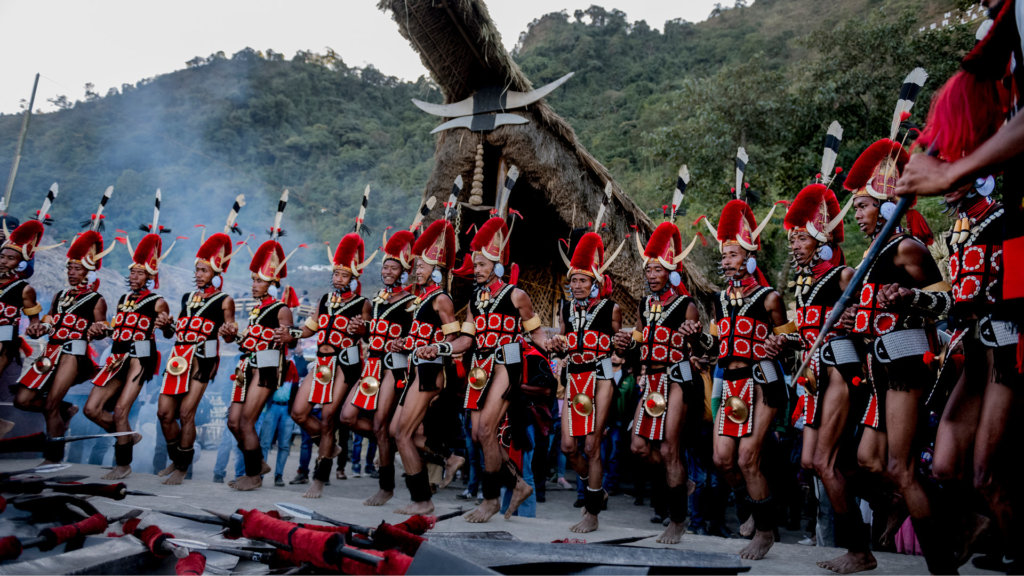
Daily programmes include folk songs, group dances, ceremonial scenes, indigenous games and demonstrations of customary life. Cultural troupes wear community-specific textiles, ornaments and headgear. Performances may represent harvesting, friendship, warrior memory, courtship or thanksgiving.
The shared arena allows visitors to compare form and movement across tribes. It also gives performers from smaller or distant communities a state-level audience. Yet a stage presentation is necessarily shorter than the original village event. For this reason, organisers must explain the occasion and meaning instead of showing only spectacle.
Handloom, Handicraft and Food
Artisans sell shawls, woven products, bamboo and cane objects, woodwork, pottery, jewellery and other crafts. The festival can connect producers directly with buyers and create orders beyond the ten-day event. The chapter on traditional Naga art, textiles and crafts explains this material background.
Food stalls introduce visitors to smoked meat, bamboo shoot, fermented ingredients, local vegetables, rice preparations and community-specific dishes. Cuisine is part of cultural knowledge because it reflects cultivation, forest use, preservation methods and seasonal availability.
Music, Literature and Contemporary Culture
The festival does not present culture as if it ended in the past. Contemporary music events, fashion, film, photography, literature and visual art show how Naga people express identity today. In addition, rock, gospel, folk fusion and independent music attract audiences beyond the traditional cultural arena.
This combination matters. Heritage survives through transmission and adaptation, not by freezing communities in an earlier period. A modern Naga musician and a traditional folk singer belong to different parts of the same changing cultural landscape.
Indigenous Sports and Public Events
Naga wrestling, archery, traditional games and strength contests appear in the broader programme. Different editions have also included food competitions, village walks, motor events and adventure activities. Such events lengthen visitor stay and distribute attention beyond the main performance ground.
The exact programme changes each year, so an examination answer should distinguish permanent features—December dates, Kisama, tribal participation and cultural tourism—from activities that may be edition-specific.
Economic Importance of the Hornbill Festival
Hornbill creates seasonal demand for accommodation, transport, food, guiding, craft and local services. Homestays and small enterprises can benefit when visitors travel beyond Kohima. Media coverage gives Nagaland national and international visibility.
The economic effect is not automatic or equally distributed. Kisama and Kohima receive the greatest concentration, while distant districts may gain less. Better tourism circuits, local procurement, transparent stall allocation and support for artisans can spread benefits more widely.
Cultural Integration and Exchange
By bringing tribal troupes into one venue, the festival encourages interaction among communities that have distinct languages and historical experiences. It presents diversity within a shared state identity. Participation by performers from other North-Eastern states and invited groups also creates inter-state cultural exchange.
The idea of unity should not erase difference. The value of Hornbill lies in allowing each community to name and explain its own tradition while participating in a common public event.
Tourism Challenges at the Hornbill Festival
A large festival places pressure on roads, traffic, water, sanitation, waste management, parking and prices. Plastic and food waste can damage the landscape if collection and disposal fail. Heavy visitor concentration can also inconvenience nearby villages.
Sustainable management requires public transport, waste segregation, adequate toilets, regulated vending, visitor information and respect for community spaces. Therefore, planners should judge tourism success not only by arrivals but also by local benefit and environmental cost.
Representation and Commercialisation
Critics sometimes argue that a short stage performance turns a living tradition into a tourist product. Commercial presentation creates a real risk when it detaches rituals from meaning, copies designs without attribution or shows communities through an unchanging “tribal” image.
The answer is not to abandon the festival. Community control over representation, accurate programme notes, fair payment to troupes and artisans, and opportunities for younger members to learn can make the event a platform for cultural agency.
The 2021 Cancellation and Public Memory
The government cancelled the festival midway in December 2021 after the killing of civilians at Oting in Mon district. The decision expressed mourning and solidarity. It also demonstrated that Hornbill connects with the political and emotional life of the state and remains tied to events affecting its people.
Hornbill Festival as Living Heritage
The festival succeeds when it strengthens the cultural activity that exists in villages throughout the year. A ten-day display cannot replace language transmission, local festivals, artisan livelihoods or community institutions. It can, however, provide visibility, income and a reason for documentation.
A balanced NPSC assessment should describe Hornbill as a government-created cultural tourism platform with major integrative and economic value, while also examining sustainability, authenticity and fair distribution of benefits.
Hornbill Festival: NPSC Prelims and Mains Points
- The Hornbill Festival began in 2000.
- It is held annually from 1 to 10 December.
- The principal venue is the Naga Heritage Village at Kisama near Kohima.
- It is called the “Festival of Festivals” because it brings many tribal traditions onto a common platform.
- Its major components include cultural performances, morungs, handloom, handicraft, cuisine, music and indigenous sports.
- The festival supports tourism and cultural visibility but faces challenges of waste, traffic, commercialisation and unequal benefit.
Compare this modern state festival with the major tribal festivals of Nagaland and their agricultural calendars. Find the whole culture section on the Nagaland PSC Notes page. The Nagaland PSC Foundation Course 2026–2027 provides guided study.
Frequently Asked Questions
When and where is the Hornbill Festival held?
It is held from 1 to 10 December, mainly at the Naga Heritage Village in Kisama near Kohima.
Is the Hornbill Festival an ancient tribal festival?
No. The Government of Nagaland launched it in 2000 as a common cultural and tourism platform. The tribal festivals represented within it have their own older histories.
Why is Hornbill called the Festival of Festivals?
It gathers cultural performances, crafts, food and representative morungs from many Nagaland tribes at one venue during the same ten-day period.