
 Forest Services
Introduction: Jharkhand Economic Growth – An Emerging Success Story
Jharkhand's economy has shown significant recovery and progress in recent years, with a strong focus on industrial development and service sector growth. The Jharkhand Economic Growth trajectory, detailed in the Jharkhand Economic Survey 2023-24, highlights improvements in GSDP, rising per capita income, and sectoral transformations. This article dives into Jharkhand's growth trends, challenges, and future prospects.
Jharkhand Economic Growth Post-COVID-19 Recovery
Jharkhand experienced impressive recovery post-pandemic, driven by key economic reforms and industrial expansion:
- GSDP Growth: Between 2020-21 and 2022-23, Jharkhand’s GSDP grew at an average rate of 8.8%.
- Projected Growth: The GSDP is expected to grow by 7.1% in 2023-24 and 7.7% in 2024-25.
This rapid growth demonstrates Jharkhand’s resilience and highlights its economic potential.
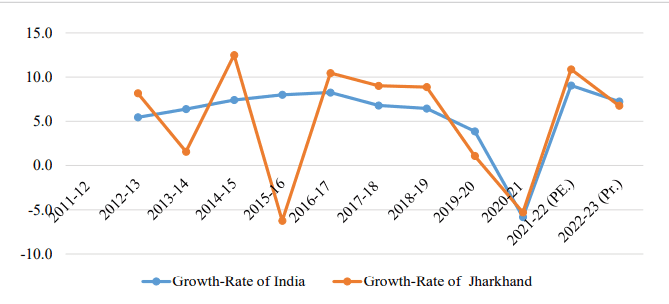
Jharkhand Economic Growth
Sectoral Analysis of Jharkhand Economic Growth
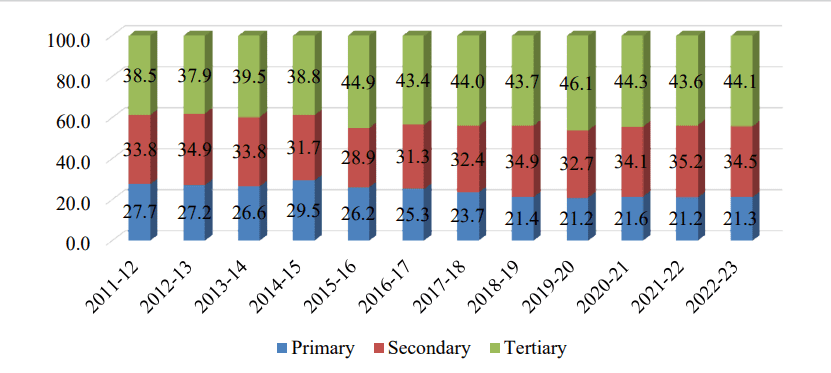
Primary Sector Decline
The primary sector, including agriculture, forestry, and mining, plays a critical role but has seen a declining share in the economy:
- In 2022-23, the primary sector contributed 21.3% to the GSVA.
- Mining growth remained sluggish at just 1.5%, necessitating diversification into other sectors.
Stability in the Secondary Sector
The secondary sector, covering manufacturing and construction, has remained stable:
- It contributed 34.5% to GSVA in 2022-23.
- Strong growth in manufacturing is driving employment and industrial development.
Tertiary Sector Driving Jharkhand Economic Growth
The service sector has emerged as the key driver of economic transformation:
- Contributed 38.8% of GSVA in 2022-23.
- Growth in trade, transportation, and public services reflects a shift towards a service-oriented economy.
Rising Per Capita Income in Jharkhand
Jharkhand’s per capita income shows consistent growth, signaling improving living standards:
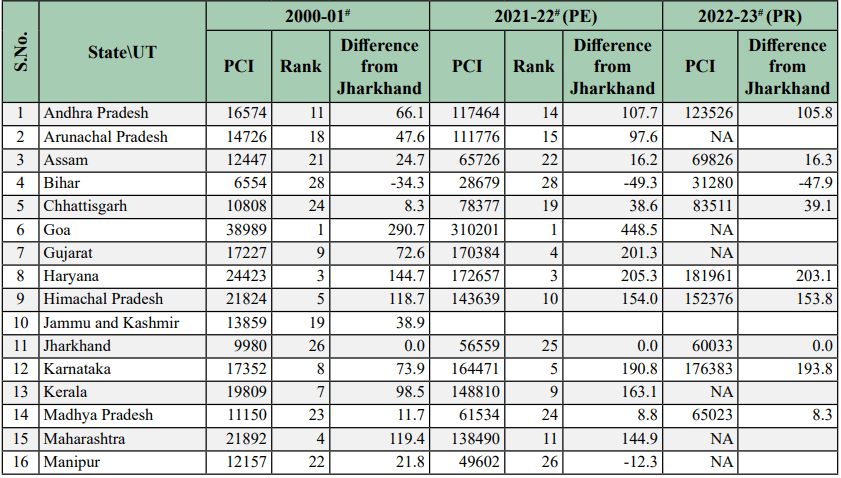
- Increased from ₹51,464 in 2020-21 to ₹60,033 in 2022-23.
- Despite the growth, Jharkhand lags behind the national average, requiring focused policy interventions to bridge the gap.
Challenges Impacting Jharkhand Economic Growth
While Jharkhand’s economic progress is commendable, it faces critical challenges:
- Skill Gaps: A mismatch between workforce skills and industry demands limits growth.
- Sectoral Imbalances: Over-dependence on mining hampers diversification.
- Infrastructure Gaps: Improved infrastructure in transportation and energy is needed for sustainable growth.
- Inflation Management: Stable inflation rates are essential for economic stability and purchasing power.
Strategies to Boost Jharkhand Economic Growth
To address these challenges and sustain growth, Jharkhand must focus on:
- Investing in Infrastructure: Enhancing roads, railways, and energy supply.
- Promoting Manufacturing: Attracting industries through incentives and ease of doing business.
- Skill Development: Expanding programs like PMKVY and Mukhya Mantri Sarthi Yojna.
- Diversifying Economy: Reducing mining dependence by boosting agriculture and services.
Jharkhand in Comparison to Other States
Jharkhand ranks lower in per capita income compared to several Indian states, but progress is visible:
- Investments in industrial policies and service sector reforms are driving upward mobility.
- Steady improvement in per capita income and GSDP showcases Jharkhand's economic potential.
Conclusion – The Future of Jharkhand Economic Growth
The Jharkhand Economic Growth story reflects resilience, progress, and potential. With a GSDP growth rate of 8.8% post-pandemic and strong forecasts for 2024, Jharkhand is on a path to sustainable development. Addressing challenges like skill gaps, sectoral imbalances, and infrastructure gaps will further accelerate its growth.
Jharkhand’s focus on industrial expansion, service sector growth, and human capital development can position it as a leading state in India’s economic landscape.
Further Reading
- Learn more about India’s GSDP trends: Economic Survey of India
- Explore Jharkhand’s Industrial Policy: Government of Jharkhand
- Skill Development Programs: PMKVY Official Site
- JPSC official Site : https://www.jpsc.gov.in/
Posts related to JPSC on LearnPro’s website:
General Introduction to Jharkhand for JPSC Exam: Gain a comprehensive understanding of Jharkhand’s history, geography, economy, and culture, crucial for the JPSC exam.
JPSC Notes: Access expertly curated notes covering essential topics for both JPSC Prelims and Mains exams.
14th JPSC PT Exam Comprehensive Test Series: Enhance your preparation with a structured test series designed to cover all aspects of the JPSC Preliminary Test syllabus, emphasizing Jharkhand-specific topics and current affairs.
JPSC Notification 2024: Stay informed about the latest updates, including exam dates, eligibility criteria, and vacancy details for the JPSC 2024 examination.
[](https://learnpro.graphy.com/courses/14th-JPSC-Test-Series--6752fcb6da6f046a25e90f7e)
Practice Questions for UPSC
Prelims Practice Questions
- 1. The tertiary sector is the largest contributor to GSVA in Jharkhand.
- 2. Jharkhand’s GSDP growth is forecasted to be lower than 7.1% in 2023-24.
- 3. The primary sector has experienced an increase in its contribution to the economy.
Which of the above statements is/are correct?
- 1. Jharkhand has no significant skill gaps in its workforce.
- 2. Over-dependence on mining is a critical challenge for diversification.
- 3. Infrastructure in Jharkhand is well-developed and does not require improvement.
Frequently Asked Questions
What has been the average growth rate of Jharkhand’s GSDP between 2020-21 and 2022-23?
Jharkhand’s Gross State Domestic Product (GSDP) grew at an average rate of 8.8% between 2020-21 and 2022-23. This impressive growth reflects the state's economic recovery post-COVID-19 and its potential for future development.
How does Jharkhand's per capita income compare to the national average?
Jharkhand's per capita income has risen from ₹51,464 in 2020-21 to ₹60,033 in 2022-23. However, it still lags behind the national average, indicating a need for targeted policy efforts to enhance living standards.
What are the main sectors contributing to Jharkhand's economy, and which is the largest?
In Jharkhand's economy, the tertiary sector, which includes services, has become the largest contributor at 38.8% of the Gross State Value Added (GSVA) in 2022-23. The secondary sector follows at 34.5%, while the primary sector's contribution remains at 21.3% and is declining.
What challenges does Jharkhand face in achieving sustainable economic growth?
Jharkhand faces several challenges, including skill gaps in the workforce, sectoral imbalances due to over-reliance on mining, deficiencies in infrastructure, and the need for effective inflation management. Addressing these issues is crucial for facilitating sustained economic growth.
What strategies have been proposed to boost Jharkhand’s economic growth?
To bolster its economic growth, Jharkhand should invest in infrastructure development, promote manufacturing by attracting industries, focus on skill development through programs, and diversify its economy by enhancing agriculture and service sectors. These strategies aim to address existing challenges and harness the state's economic potential.
About LearnPro Editorial Standards
LearnPro editorial content is researched and reviewed by subject matter experts with backgrounds in civil services preparation. Our articles draw from official government sources, NCERT textbooks, standard reference materials, and reputed publications including The Hindu, Indian Express, and PIB.
Content is regularly updated to reflect the latest syllabus changes, exam patterns, and current developments. For corrections or feedback, contact us at admin@learnpro.in.