
Brief Context
India needs to accelerate its efforts in the global supply chain, as critical minerals are emerging as the defining geoeconomic axis of the 21st century.
Source Content
Syllabus: GS3/Economy; Science & Technology
Context
- India needs to accelerate its efforts in the global supply chain, as critical minerals are emerging as the defining geoeconomic axis of the 21st century.
About Critical Minerals
- These are the minerals that are essential for the production of modern technologies. They are important for national security and the economy.
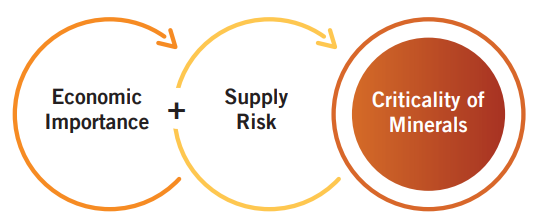
- These minerals are labelled as critical because of their lack of availability (spatial distribution), methods of extraction or processing, and vulnerability and disruption in supply chains.
- These minerals impact the economy relatively higher than the other raw materials when the risk of supply shortage.
Global Landscape: Strategic Concentration and China’s Dominance
- These minerals are geographically concentrated, opaque supply chains, and complex midstream processing with China dominating the midstream processing stage — refining over 90% of rare earths, 70% of cobalt, and 60% of lithium.
- It creates a strategic vulnerability for countries like India that rely heavily on imports.
India’s Position
- India is 100% import-dependent for several critical minerals, including lithium, cobalt, and rare earths.
- National Critical Mineral Mission (NCMM) aims to secure supply chains and reduce dependency. It includes:
- Identifying 30 critical minerals (Ministry of Mines) essential for national security, economic development, and technological advancement, that are indispensable for:
- Clean energy transitions (e.g., solar panels, wind turbines, EV batteries);
- Digital infrastructure (e.g., semiconductors, smartphones);
- National security (e.g., defense equipment, satellites)
- Auctioning Mineral Blocks (five tranches completed);
- Accelerating domestic exploration (422 projects in three years): India is rapidly expanding its exploration:
- 195 projects completed in the past year
- 227 projects approved for the current year
- Identifying 30 critical minerals (Ministry of Mines) essential for national security, economic development, and technological advancement, that are indispensable for:
Key Challenges
- Refining and Processing Gap: The country remains 100% import-dependent for refining lithium, cobalt, rare earths, and other battery-grade materials.
- Strategic Risks and Industrial Vulnerabilities: China’s recent export restrictions on rare earths have already impacted India’s automotive industry.
- Electric vehicle (EV) and internal combustion engine (ICE) production are both reliant on rare earth magnets, making supply security critical.
- Other Challenges:
- High capital costs and limited processing capacity;
- Lack of technically qualified bidders; domestic refining capacity; and shortage of qualified bidders
- Midstream bottlenecks in refining and conversion
Strategic Solutions
- Establish dedicated mineral processing zones with modern infrastructure
- Offer Production-Linked Incentives (PLI) to attract private investment
- Develop a stockpiling framework to buffer against supply shocks
- ESG Compliance and Community Engagement: Sustainable mining is non-negotiable. Many critical mineral reserves are located in tribal belts, and ecologically sensitive zones.
- India needs to adopt robust ESG frameworks, including third-party audits, transparent environmental assessments, and community benefit-sharing and consultation mechanisms.
- Towards Circularity and Sustainability: To reduce import dependency, India needs to build a circular economy for critical minerals:
- Battery and electronics recycling must shift from informal to formal systems;
- Investments in collection, dismantling and recovery infrastructure are necessary;
- Incentives should be provided to recyclers to encourage participation.
- Strategic Alignment and Institutional Support: Effective policymaking will require:
- Ongoing demand-supply assessments;
- Dynamic reassessment of the critical minerals list;
- Technological foresight to adapt to changing industrial needs.
Global Alliances and Friendshoring
- India’s international efforts include joining the Mineral Security Partnership; and forging bilateral ties with Australia, Argentina, and others.
- Geopolitical platforms like the QUAD and G20 should be leveraged to diversify supply chains; build joint ventures; and enable best-practice sharing.
- Additionally, India needs to establish a critical mineral stockpiling framework to buffer against shocks.
Road Ahead
- India’s ambitions for technological sovereignty and clean energy leadership hinge on its ability to secure critical minerals. It requires:
- Timely execution of policies;
- Sustained institutional support;
- Strategic alignment with foreign policy goals
| Daily Mains Practice Question [Q] Discuss the strategic importance of critical minerals for India’s economic and national security goals. What policy measures should India prioritize to ensure a resilient and self-reliant supply chain in the face of global competition and geopolitical uncertainties? |