
Brief Context
Context The conflict around the Strait of Hormuz has highlighted how modern power still runs through a surprisingly small number of vulnerable trade routes. About During the First World War, the struggle over the Dardanelles was driven by the strategic importance of a narrow waterway linking the Mediterranean to the Black Sea. The Dardanelles is a strategically significant strait that serves as a natural boundary between Europe and Asia, separating the Gallipoli peninsula in Eastern Europe from
Source Content
Syllabus: GS2/IR
Context
- The conflict around the Strait of Hormuz has highlighted how modern power still runs through a surprisingly small number of vulnerable trade routes.
About
- During the First World War, the struggle over the Dardanelles was driven by the strategic importance of a narrow waterway linking the Mediterranean to the Black Sea.
- The Dardanelles is a strategically significant strait that serves as a natural boundary between Europe and Asia, separating the Gallipoli peninsula in Eastern Europe from Anatolia in Asia.
- In the Second World War, the Battle of the Atlantic was essentially a contest over whether Britain and its allies could keep open the sea routes on which the war depended.
- Choke points did not merely influence those conflicts; they helped determine their outcome.
- Strait of Hormuz: It is one of the world’s most critical maritime choke points, carrying roughly one-fifth of global oil and petroleum consumption and a similar share of liquefied natural gas (LNG) trade in early 2025.
Other Choke Points
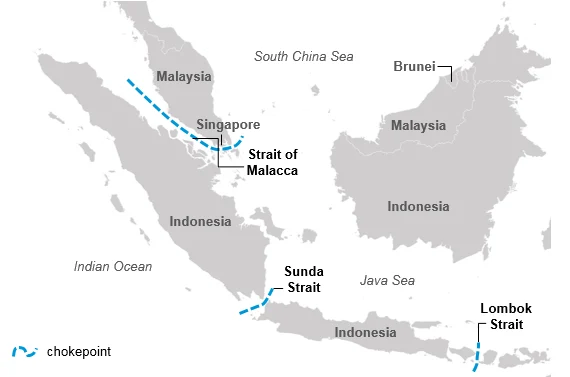
- Malacca Strait: A similar vulnerability runs through the Malacca Strait into the South China Sea.
- Malacca is the world’s busiest oil transit corridor, linking Gulf producers to east Asia’s industrial economies, while the South China Sea carries roughly one-third of global shipping.
- Any conflict or disruption in the wider region would threaten not just the maritime routes surrounding it, but also global supply chains.
- The Strait of Bab el-Mandeb: Disruptions at the Bab el-Mandeb Strait in the Red Sea quickly raise shipping costs, delay deliveries, and affect food prices.
Modern Chokepoints Beyond Sea Routes
- Industrial and Digital Systems: Taiwan and China dominates global foundry capacity and produces most of the world’s most advanced logic chips.
- It has turned the Taiwan Strait into a double choke point: a shipping corridor on one side, a fabrication bottleneck on the other.
- Any conflict or disruption would cut the supply of components of smartphones to cloud computing and modern vehicles.
- Netherlands, ASML is the sole commercial supplier of extreme ultraviolet lithography machines, without which the most advanced semiconductors cannot be mass-produced.
- Race for Resources: Rare earths and minerals that form the components on which high-tech devices rely are also now a critical global choke point.
- China is the leading refiner for 19 of 20 important strategic minerals, this means that the industries meant to define the coming era are exposed to a small set of processing hubs.
- Subsea Cables: Subsea cables carry the overwhelming majority of intercontinental traffic, and Egypt has become one of the critical passage points for cables linking Europe and Asia.
- More than 90% of Europe-Asia subsea cable capacity runs through the Red Sea cable corridor, making it a choke point of a different kind.
- Climate Change: The Panama Canal has faced another increasingly-frequent disruption to trade flows – that of climate change.
- Reduced water levels in the region constrained canal traffic and forced shippers to reroute or wait, highlighting how climate stress is now a first-order geopolitical variable.
Conclusion
- The Iran war has exposed the fragility of a global order built on narrow corridors and concentrated capabilities.
- In normal times, these choke points are easy to overlook but in wartime, or even prolonged crises, they reappear as hidden levers of escalation.
- Today’s choke points also include chip fabs, lithography tools and fibre-optic cables on the ocean floor which have widened the vulnerability.
- The strategic significance of choke points lies not just in their throughput but in the absence of substitutes.
Source: WEF