
Brief Context
Context According to a new study published in Nature, the increasing ferocity of wildfires means that more than 30% of the Arctic Boreal Zone (ABZ) has now stopped capturing carbon and is instead releasing it. About The findings align with the National Oceanic and Atmospheric Administration (NOAA’s) 2024 Arctic Report Card. It also highlighted that the Arctic tundra, a treeless region, is becoming a net carbon source, largely due to warming temperatures and escalating wildfire activity in the No
Source Content
Syllabus: GS3/Environment
Context
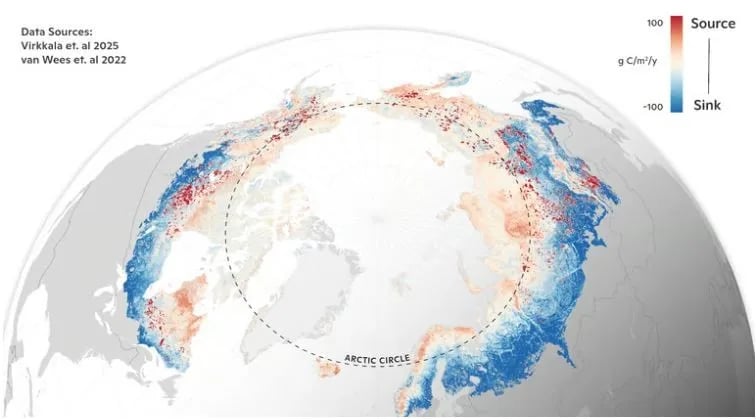
- According to a new study published in Nature, the increasing ferocity of wildfires means that more than 30% of the Arctic Boreal Zone (ABZ) has now stopped capturing carbon and is instead releasing it.
About
- The findings align with the National Oceanic and Atmospheric Administration (NOAA’s) 2024 Arctic Report Card.
- It also highlighted that the Arctic tundra, a treeless region, is becoming a net carbon source, largely due to warming temperatures and escalating wildfire activity in the Northern polar region.
The Arctic Boreal Zone (ABZ)
- ABZ is a critical region in the northern hemisphere, characterized by its unique ecosystems and significant role in regulating global carbon cycles.
- Geographical Location:
- The ABZ spans across the Arctic Circle, including parts of Alaska, northern Europe, and Siberia.
- It includes tundra, coniferous forests, wetlands, and permafrost regions.
- Carbon Sink: The ABZ has historically acted as a significant carbon sink, absorbing large amounts of carbon dioxide (CO₂) from the atmosphere through its forests, soil, and permafrost.
- The tundra and wetlands in the ABZ sequester carbon in the form of organic material frozen in permafrost, which helps mitigate global warming.
Recent Wildfires:
- Multiple U.S. states (Texas, Oklahoma, California) and Japan (Ofunato) faced severe wildfires in early 2025.
- India’s forest fire hotspots dropped, but the number of fires remains high, particularly in Uttarakhand, Odisha, and Chhattisgarh.
- Rising land temperatures and prolonged heat waves contribute to more intense fires.
Carbon Emissions:
- Wildfires in January 2025 released 800,000 tonnes of carbon, nearly four times the amount released a decade ago.
- Wildfires worldwide significantly contribute to carbon emissions, including 69 million tonnes annually in India.
Carbon Sinks and the Arctic Boreal Zone (ABZ):
- Oceans, forests, and soil are carbon sinks, but wildfires have disrupted their ability to absorb carbon.
- The ABZ, once a significant carbon sink, has started releasing carbon, especially due to thawing permafrost and increased wildfires.
- Over 30% of the ABZ now releases carbon, reversing its long-standing role as a carbon sink.
Source: TH