
Brief Context
In News The Union Ministry of Power is considering mandating that new air conditioners (ACs) in India operate only within a temperature range of 20°C to 28°C. Functioning of Air conditioner It works by transferring heat from one place to another using a refrigerant in a vapour-compression cycle. It absorbs heat from indoor air via an evaporator, where the refrigerant boils and dehumidifies the air.
Source Content
Syllabus: GS 3/Science
In News
- The Union Ministry of Power is considering mandating that new air conditioners (ACs) in India operate only within a temperature range of 20°C to 28°C.
| Do you know? – In 2018, the International Energy Agency estimated there were 2 billion ACs in use around the world and that the number of residential units tripled from 2000 to 2022, to 1.5 billion. – The agency also said that as of 2022, 43% of people in the Asia Pacific region were still in need of additional cooling. – India is currently adding 10 to 15 million ACs each year, with another 150 million expected over the next decade. |
Functioning of Air conditioner
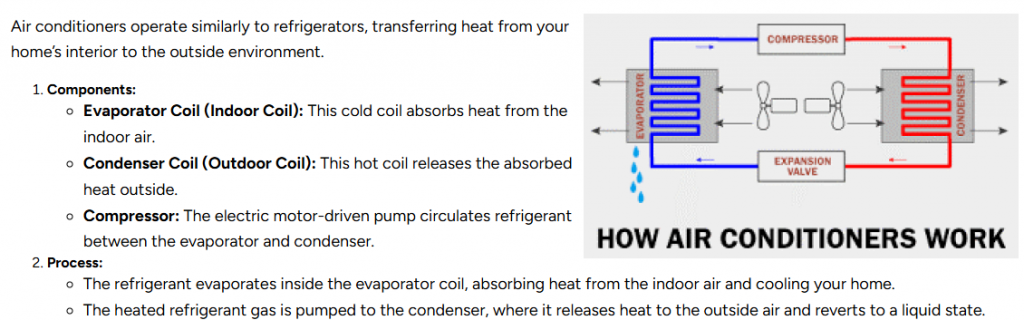
- It works by transferring heat from one place to another using a refrigerant in a vapour-compression cycle.
- It absorbs heat from indoor air via an evaporator, where the refrigerant boils and dehumidifies the air.
- The refrigerant, now a superheated vapour, is compressed—raising its temperature and consuming most of the AC’s power.
- It then releases heat to the outside through the condenser, condenses back into a liquid, and is expanded to a low-pressure mix before returning to the evaporator.
- It is most efficient when the refrigerant operates within its optimal temperature range for heat absorption and release.
Concerns related to low temperatures
- Health experts and international guidelines highlight that temperatures below 18°C are not only uncomfortable but also harmful, increasing risks of hypertension, asthma, respiratory infections, and mental health issues, particularly among the elderly and children.
- Technically, ACs consume the most power during compression, and they operate most efficiently within certain thermal ranges that align with the proposed limits.
- The World Health Organization and various studies have confirmed that indoor temperatures below 18°C can negatively impact cardiovascular and respiratory health, lead to higher cholesterol, lower vitamin D levels, and even contribute to depression and anxiety.
Proposed restriction of Government
- The Restriction was previously proposed in 2018 and 2021, aims to conserve energy and promote public health.
- The new restriction would apply to homes, hotels, and cars.
- The move aims to promote energy efficiency and public health, with India’s AC load projected to hit 200 GW by 2030.
Relevence
- Studies by the Bureau of Energy Efficiency (BEE) show that raising the AC temperature by just 1°C can save about 6% in electricity consumption, and setting ACs at a default temperature of 24°C could save up to 20 billion units annually.
- The proposed restriction supports both energy efficiency and health, making a strong case for regulation.
Source :TH
| Read this in Hindi: सही एसी तापमान के पीछे का विज्ञान |