
Brief Context
Context Defence Research and Development Organisation (DRDO) inaugurated the Quantum Technology Research Centre (QTRC). About Aim: To strengthen indigenous quantum capabilities for strategic and defence applications. QRTC is equipped with state-of-the-art experimental set-ups designed to propel research and development in critical quantum domains.
Source Content
Syllabus: GS3/Science and Technology
Context
- Defence Research and Development Organisation (DRDO) inaugurated the Quantum Technology Research Centre (QTRC).
About
- Aim: To strengthen indigenous quantum capabilities for strategic and defence applications.
- QRTC is equipped with state-of-the-art experimental set-ups designed to propel research and development in critical quantum domains.
- The key capabilities of this centre include:
- Characterisation of Vertical-Cavity Surface-Emitting Lasers and Distributed Feedback Lasers;
- Test-beds for evaluating single-photon sources;
- Set-up for characterisation of Micro Fabricated Alkali Vapor Cell;
- Experimental platforms for developing and validating Quantum Key Distribution techniques to enable ultra-secure communication and safeguard national security in the post-quantum era, spearheaded by Scientific Analysis Group (SAG), DRDO.
QTRC also focuses on Foundational Technologies
- Foundational Technologies (led by SSPL):
- Ultra-Small Atomic Clock based on Coherent Population Trapping for precise timekeeping in GNSS-denied environments.
- Atomic Magnetometer using optically pumped magnetometry for ultra-sensitive magnetic field detection.
- Research on cutting-edge solid-state quantum devices and materials.
Quantum Technology
- Quantum technology is a rapidly advancing field that leverages the principles of quantum mechanics to develop new technologies with unprecedented capabilities.
- Quantum mechanics is the branch of physics that studies the behavior of particles at the quantum level, where classical physics no longer applies.
- Quantum technology harnesses the unique properties of quantum systems, such as superposition and entanglement, to perform tasks that were previously thought impossible or significantly enhance existing capabilities.
- Four domains of quantum technologies:
- Quantum communication: It applies the properties of quantum physics to provide better security and improved long-distance communications.
- Quantum simulation: It refers to the use of a quantum system to simulate the behavior of another quantum system.
- Quantum computation: It is a field of computing that utilizes the principles of quantum mechanics to perform certain types of calculations more efficiently than classical computers.
- Quantum sensing and metrology: It leverages the principles of quantum mechanics to achieve highly precise measurements.
National Quantum Mission (NQM)
- The government approved the NQM in 2023 from 2023-24 to 2030-31.
- Aim: To seed, nurture and scale up scientific and industrial R&D and create a vibrant & innovative ecosystem in Quantum Technology (QT).
- This will accelerate QT led economic growth, nurture the ecosystem in the country and make India one of the leading nations in the development of Quantum Technologies & Applications (QTA).
- Objectives: The Mission objectives include developing intermediate-scale quantum computers with 50-1000 physical qubits in 8 years in various platforms like superconducting and photonic technology.
- Satellite-based secure quantum communications between ground stations over a range of 2000 kilometers within India, long-distance secure quantum communications with other countries, inter-city quantum key distribution over 2000 km as well as multi-node Quantum networks with quantum memories.
- Developing magnetometers with high sensitivity in atomic systems and Atomic Clocks for precision timing, communications, and navigation.
- It will also support the design and synthesis of quantum materials such as superconductors, novel semiconductor structures, and topological materials for the fabrication of quantum devices.
- Single photon sources/detectors, and entangled photon sources will also be developed for quantum communications, sensing, and metrological applications.
- Implementation:Four Thematic Hubs (T-Hubs) have been set up, bringing together 14 Technical Groups across 17 states and 2 Union Territories.
- Indian Institute of Science (IISc) Bengaluru
- Indian Institute of Technology (IIT), Madras in association with the Centre for Development of Telematics, New Delhi
- Indian Institute of Technology (IIT), Bombay
- Indian Institute of Technology (IIT), Delhi.
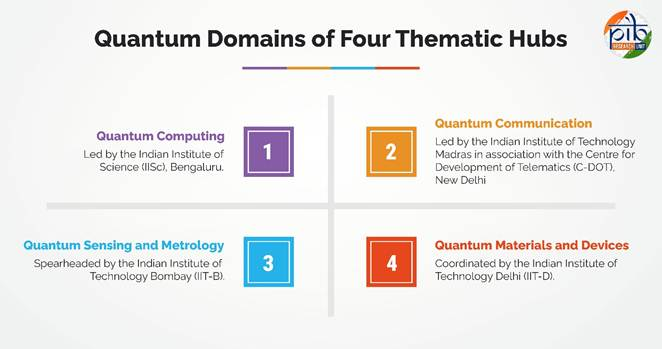
Source: PIB