
Brief Context
Context May 11 marked the 27th National Technological Day of India. About Former Prime Minister Atal Bihari Vajpayee designated May 11 as National Technology Day in India to commemorate the Pokhran nuclear tests conducted by the Indian Army in 1998. On May 11, 1998, two other special technological advances were showcased by India’s scientists and engineers.
Source Content
Syllabus: GS3/Science and Technology
Context
- May 11 marked the 27th National Technological Day of India.
- This year’s theme is “YANTRA”, which signifies transformation through advanced research and technological acceleration.
About
- Former Prime Minister Atal Bihari Vajpayee designated May 11 as National Technology Day in India to commemorate the Pokhran nuclear tests conducted by the Indian Army in 1998.
- On May 11, 1998, two other special technological advances were showcased by India’s scientists and engineers.
- The successful test firing of Trishul missile; and the first test flight of the indigenously developed aircraft Hansa.
- This observance aims to cultivate a scientific mindset and inspire the younger generation to pursue careers in technology, engineering, and mathematics.
| Do You Know? – India is currently among nine countries in the world that have a publicly known nuclear weapons programme.Homi Jehangir Bhabha is credited with pioneering India’s nuclear programme. |
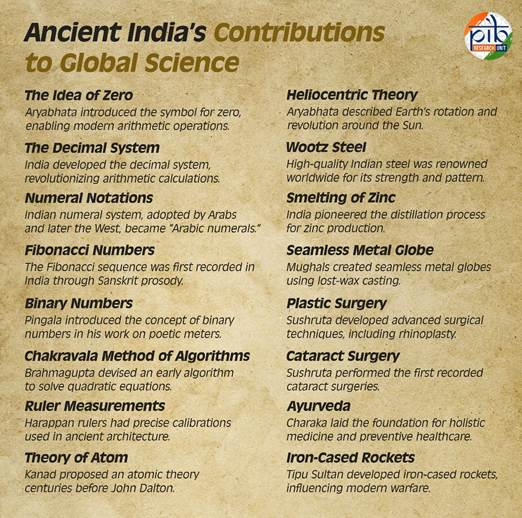
Ancient India’s Contribution to Science
India’s Technological Achievements
- India secured the 39th rank in the Global Innovation Index 2024 and 6th position in global Intellectual Property (IP) filings, as per the WIPO report.
- The Network Readiness Index (NRI) 2024 also marked India’s rise to 49th place from 79th in 2019, showcasing advancements in ICT infrastructure and digital transformation.
- India has also emerged as the third-largest startup ecosystem in the world, fostering entrepreneurship and technological advancement.
- India’s Agricultural Achievements:
- Green Revolution (1960s–1970s): Introduction of high-yielding varieties (HYVs) of wheat and rice.
- White Revolution (1970s): India became the world’s largest milk producer, ending milk imports.
- India’s Indigenous Defence Technology Achievements:
- INS Kalvari (1967): India’s first indigenous naval submarine, marked the beginning of ‘Made-in-India’ defence capabilities.
- Agni Series: Long-range ballistic missiles for strategic deterrence.
- Prithvi Series: Surface-to-surface tactical missiles.
- BrahMos: Co-developed with Russia, world’s fastest supersonic cruise missile.
- Tejas (LCA): India’s first indigenously developed supersonic fighter jet.
- INS Arihant: India’s first ballistic missile nuclear submarine.
- INS Vikrant (2022): First indigenous aircraft carrier, a major naval milestone.
- India’s Indigenous Space Technology Achievements:
- Chandrayaan-1 (2008): India’s first lunar mission. Became the 4th country to send a probe to the moon.
- Discovered water molecules on the lunar surface—a groundbreaking scientific achievement.
- Mars Orbiter Mission (Mangalyaan, 2013): India became the first nation to reach Mars on its first attempt.
- 104 Satellites in One Launch (2017): Set a world record for the most satellites deployed in a single mission.
- Chandrayaan-3 (2023): Achieved a soft landing near the Moon’s south pole, a global first.
- Aditya-L1 (2023): India’s first solar mission, studying the Sun’s outer layers.
- Gaganyaan (2027): India’s first crewed spaceflight mission.
- Shukrayaan (2028): Venus orbiter mission, aiming to explore the planet’s dense atmosphere.
- Chandrayaan-1 (2008): India’s first lunar mission. Became the 4th country to send a probe to the moon.
- Digital Infrastructure:
- Aadhaar: World’s largest biometric ID system.
- UPI (Unified Payments Interface): Revolutionized digital payments and fintech.
- India leads in real-time digital transactions globally.
Government Initiatives to Boost Technology Advancements:
- Make in India (2014): Boosts domestic manufacturing, including in high-tech sectors like defence, electronics, semiconductors, and space technology.
- Atal Innovation Mission (AIM): Launched by NITI Aayog to promote a culture of innovation via: Atal Tinkering Labs (ATLs) in schools, Atal Incubation Centres (AICs) for startups.
- National Mission on Interdisciplinary Cyber-Physical Systems (NM-ICPS): Promotes R&D in AI, robotics, The Internet of Things (IoT), quantum computing, and more through dedicated Technology Innovation Hubs (TIHs).
- Technology Development Board (TDB): Provides financial support to commercialize indigenous technologies.
- National Supercomputing Mission (NSM): Aims to install a network of world-class supercomputers across premier institutions.
- National Quantum Mission (NQM): With an investment of ₹6003.65 crore over eight years, it is positioning India as a leader in quantum computing, communication, sensing, and materials.
- A total of 152 researchers from 43 institutions across 17 states and 2 Union Territories are contributing to this mission.
- IN-SPACe and NSIL (NewSpace India Ltd): Promote private sector participation in India’s space programme.
- Defence Acquisition Procedure (DAP) & iDEX (Innovations for Defence Excellence): Encourage indigenous defence startups and MSMEs to build advanced technologies.
- INSPIRE Program (DST): Encourages students to pursue science education and careers in research through scholarships and internships.
- Budgetary Allocations and Growth:
- Budgetary allocations for Gross Expenditure on Research and Development (GERD) have more than doubled, along with over a 100% increase in DST and DBT budgets.
- The space sector budget has nearly tripled, driven by the opening up of the sector to private participation—positioning India as a future-ready technological power.
Conclusion
- Government-led initiatives in India have created an ecosystem of innovation, skill development, and R&D that enables the country to grow as a global technological hub while ensuring inclusive benefits for its citizens.
Source: PIB