
Brief Context
Context A new study by researchers at IIT Gandhinagar has warned that flash floods are becoming more frequent and severe across India. What Are Flash Floods? Flash floods are sudden, intense floods that occur within six hours of a heavy rainfall event, usually in regions with steep slopes, poor drainage, or saturated/dry soil.
Source Content
Syllabus: GS3/ Disaster Management, GS1/ Geography
Context
- A new study by researchers at IIT Gandhinagar has warned that flash floods are becoming more frequent and severe across India.
What Are Flash Floods?
- Flash floods are sudden, intense floods that occur within six hours of a heavy rainfall event, usually in regions with steep slopes, poor drainage, or saturated/dry soil.
- Unlike riverine floods, they offer little warning, making them particularly deadly.
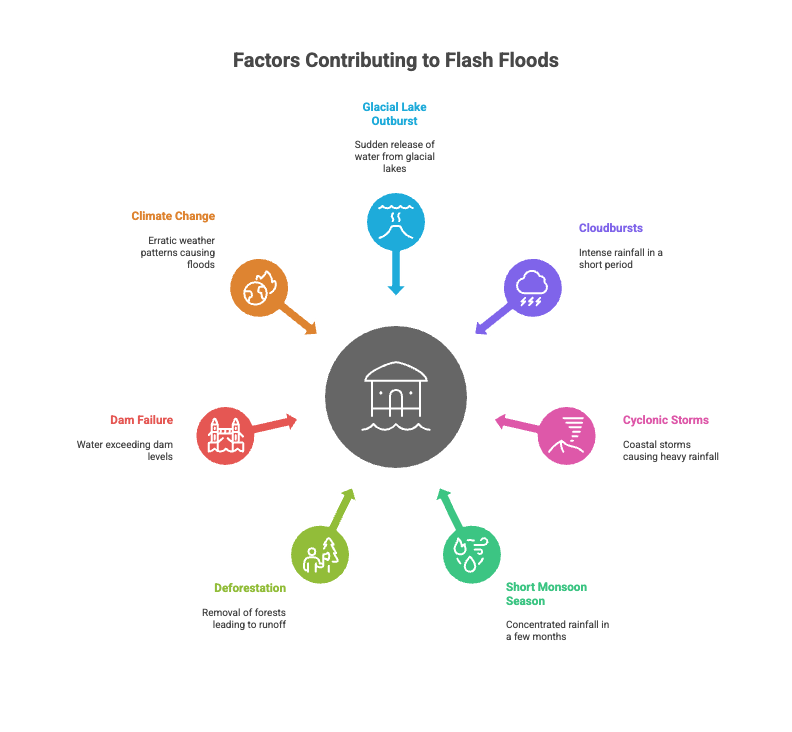
Impact of Flash Floods in India
- Human and Livelihood Impact: Flash floods lead to significant casualties due to their sudden onset.
- The 2023 flash floods in Himachal Pradesh claimed over 400 lives and displaced thousands.
- Damage to Public Utilities: Flash floods damage power lines, drinking water systems, and mobile networks, making post-disaster recovery slower and more expensive.
- Land Degradation: Torrential runoff erodes topsoil, degrades fertility, and increases sedimentation in rivers and reservoirs.
- Urban Challenges: Cities like Mumbai, Hyderabad, and Bengaluru experience rapid runoff due to concretised surfaces and encroached stormwater drains.
Initiatives taken by government
- Central Water Commission (CWC) is the nodal organisation entrusted with the task of flood forecasting & early flood warnings in the country.
- Indian Meteorological Department (IMD) in joint collaboration with the US National Weather Service, has developed a Flash Flood Guidance System (FFGS) for the South Asian region.
- The Central Government has approved the National Glacial Lake Outburst Flood Risk Mitigation Programme (NGRMP) in four Himalayan States viz. Himachal Pradesh, Uttarakhand, Sikkim and Arunachal Pradesh with a total budget of Rs.150.00 crore.
Recommendations and Adaptation Strategies
- Flash Flood Forecasting: Integrate terrain, drainage, soil data, and real-time weather.
- Early Warning Systems: Develop region-specific models that consider soil moisture and topography.
- Promote community-level alerts in vulnerable districts.
- Land-Use and Urban Planning: Ban construction in high-risk zones (e.g., floodplains, steep slopes). Build climate-resilient infrastructure in elevated roads, permeable pavements, and stormwater drains.
- Disaster Preparedness: Update flood risk maps regularly and conduct mock drills in urban and rural areas.
- Climate Adaptation in Policy: Integrate climate models into national and state disaster management frameworks. Promote nature-based solutions like wetland conservation, afforestation, and catchment restoration.
Source: IE