
Brief Context
Context The Global Environment Outlook, Seventh Edition: A Future We Choose (GEO-7), was released during the seventh session of the United Nations Environment Assembly in Nairobi. About GEO-7 is UNEPs flagship assessment published for the first time in 1997. It is a major scientific report that reviews the planet’s environmental health, policy effectiveness, and future trends, providing crucial, participatory, science-based data to guide global environmental action and policy.
Source Content
Syllabus: GS3/Environment
Context
- The Global Environment Outlook, Seventh Edition: A Future We Choose (GEO-7), was released during the seventh session of the United Nations Environment Assembly in Nairobi.
About
- GEO-7 is UNEP’s flagship assessment published for the first time in 1997.
- It is a major scientific report that reviews the planet’s environmental health, policy effectiveness, and future trends, providing crucial, participatory, science-based data to guide global environmental action and policy.
Major Highlights of the Report
- Tipping Points: Several tipping points could occur in the next few years to decades:
- shifts in intensity and timing of monsoons,
- loss of Arctic sea ice which is likely to alter the jet stream,
- change the frequency and magnitude of extreme weather events;
- abrupt thaw of permafrost likely to result in a substantial release of methane within a few years;
- the coral die-off is already underway and a collapse of the Atlantic Meridional Overturning Circulation (AMOC) could lead to rapid shifts in the climate in Europe and Africa.
- The report highlights several alarming trends: Global warming is worsening and exceeding previous estimates.
- 1 million species face extinction.
- 20–40% of land is degraded.
- Solid waste already exceeds 2 billion tonnes annually and will rise further.
- Plastic production may triple by 2060 without policy shifts.
- 9 million people die annually from pollution.
- Climate change would cut 4% off annual global GDP by 2050 and 20% by the end of the century.
- Global Warming: The world has warmed 1.3°C, with projections showing potential warming between 2.4°C to 3.9°C by 2100, potentially faster than IPCC models estimate.
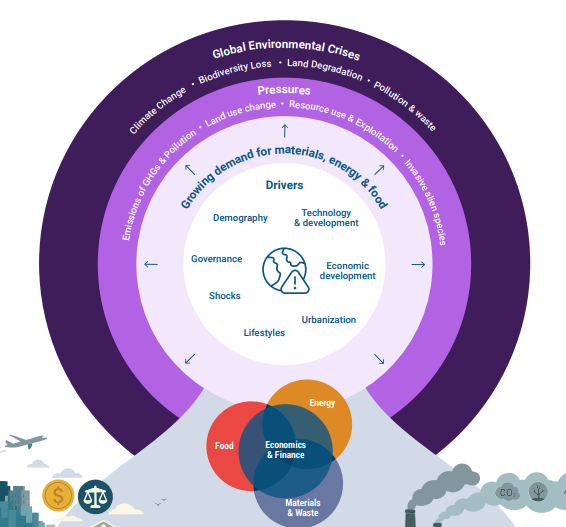
- Interconnected Drivers: Drivers like population growth, urbanization, resource-intensive lifestyles, and governance failures intensify environmental pressures.
- Failures of Current Policies: The current policies are insufficient — without transformation, none of the environmental SDGs will be achieved, and internationally agreed environmental goals (including the Paris Agreement, Kunming-Montreal Global Biodiversity Framework, and Aichi Targets) will not be met.
- India Specific: Shifts in monsoon systems can affect South Asia including India which further impacts water, agriculture, and food systems.
- Changes in monsoon circulation could exacerbate droughts, floods, and water scarcity across India.
- India faces land degradation affecting approximately 33% of its geographical area (115-120 million hectares), with major impacts on agricultural productivity and food security.
- Assessments indicate India’s current targets are “Highly insufficient” for a 1.5°C pathway, requiring strengthened ambition and international support.
Policy Recommendations
- The report outlines target-seeking scenarios showing how the world could reach environmental goals if transformative efforts occur across sectors.
- Transformation requires:
- Ambitious policies.
- Inclusive governance.
- Systematic integration of environmental goals in decision-making.
- Wide participation from governments, civil society, businesses, and Indigenous Peoples.
- The report identifies four major systems where transformation is critical:
- Economic & Financial Systems: Reform to internalize environmental costs and align finance with sustainability goals.
- Materials & Waste System: Shift to a circular economy that minimizes waste and maximizes reuse and recycling.
- Energy System: Accelerate renewable energy deployment and phase out fossil fuels, while ensuring energy access.
- Food System: Promote sustainable diets, reduce food loss/waste, and enhance resilient food production.
- Urgent transformation will deliver societal, economic, and environmental benefits worth far more than the cost of inaction — potentially generating trillions in economic gains.
Source: IE