
Brief Context
In News In a historic medical breakthrough, scientists in the United States have, for the first time, successfully used a personalized CRISPR-based gene-editing therapy to treat a rare genetic disorder Carbamoyl Phosphate Synthetase 1 (CPS1) deficiency in an infant. Applications of Gene Editing Therapy Medicine: Treating genetic disorders like Sickle Cell Anaemia, Beta-Thalassemia, CPS-1 Deficiency. Engineering immune cells (CAR-T therapy) to target cancer Agriculture: Developing disease-resista
Source Content
Syllabus: GS3/ Science & Technology
In News
- In a historic medical breakthrough, scientists in the United States have, for the first time, successfully used a personalized CRISPR-based gene-editing therapy to treat a rare genetic disorder Carbamoyl Phosphate Synthetase 1 (CPS1) deficiency in an infant.
- CPS-1 Deficiency is a rare genetic metabolic disorder where the liver lacks an enzyme to convert toxic ammonia into urea, which is usually excreted through urine.
What is Gene Editing Therapy?
- Definition:
- Gene editing therapy refers to the deliberate alteration of DNA sequences within the cells of an individual to treat or cure genetic diseases.
- It involves modifying, deleting, or inserting specific genes at targeted locations in the genome to correct mutations or enhance cellular functions.
- Types of Gene Editing Techniques:
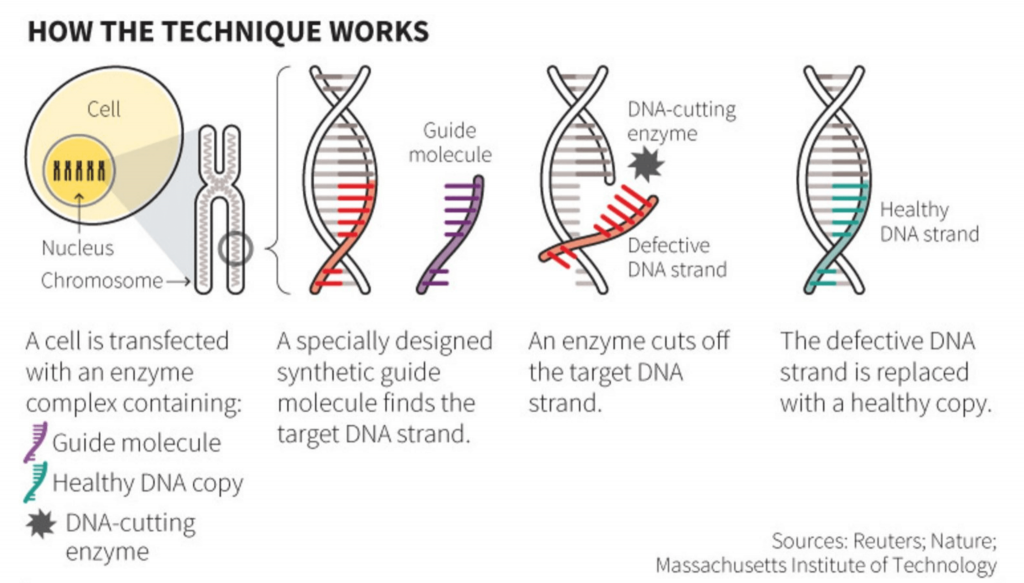
- CRISPR-Cas9: Most widely used tool; cuts DNA at specific sites using guide RNA and Cas9 enzyme
- Zinc Finger Nucleases (ZFNs): Uses engineered proteins to bind and cut DNA
- Base Editing: Alters a single nucleotide without breaking DNA strands
- Prime Editing: Acts like a ‘word processor’ to insert, delete, or replace DNA sequences
- Mechanism:
Applications of Gene Editing Therapy
- Medicine: Treating genetic disorders like Sickle Cell Anaemia, Beta-Thalassemia, CPS-1 Deficiency.
- Engineering immune cells (CAR-T therapy) to target cancer
- Agriculture: Developing disease-resistant, high-yield crops
- Veterinary Science: Enhancing livestock traits
India’s Progress in Gene Editing
- CSIR-Institute of Genomics and Integrative Biology (IGIB) is developing indigenous CRISPR platform (IndiCRISPR).
- The Department of Biotechnology (DBT) is funding genome-editing research under the National Biopharma Mission.
- Gene Therapy Guidelines (2020): Issued to streamline ethical clinical application.
Challenges
- Safety issues: Off-target effects, immune reactions, unintended mutations.
- Ethical concerns: Germline editing (heritable changes), designer babies
- Limited access: High cost, availability limited to developed nations
Source: IE