
Brief Context
Context Recently, two Indian aquanauts successfully conducted deep-sea dives in the Atlantic Ocean, part of Samudrayaan Project, under the Deep Ocean Mission. About the Deep Ocean Mission It was launched by the Ministry of Earth Sciences (MoES) with an investment of ₹4,077 crore over five years on September 7, 2021. It aims to develop technologies for exploring and sustainably utilizing deep ocean resources, and to support Indias Blue Economy and scientific leadership.
Source Content
Syllabus: GS3/Science & Technology
Context
- Recently, two Indian aquanauts successfully conducted deep-sea dives in the Atlantic Ocean, part of Samudrayaan Project, under the Deep Ocean Mission.
- Over 100 kg of cobalt-rich polymetallic nodules were collected from 1,173 meters depth in the Andaman Sea.
About the Deep Ocean Mission
- It was launched by the Ministry of Earth Sciences (MoES) with an investment of ₹4,077 crore over five years on September 7, 2021.
- It aims to develop technologies for exploring and sustainably utilizing deep ocean resources, and to support India’s Blue Economy and scientific leadership.
- Blue Economy is a core growth dimension, with potential to push India’s maritime economy beyond ₹100 billion.
- It is being implemented in phases and aligns with the UN Decade of Ocean Science for Sustainable Development (2021–2030).
Key Components of the Mission
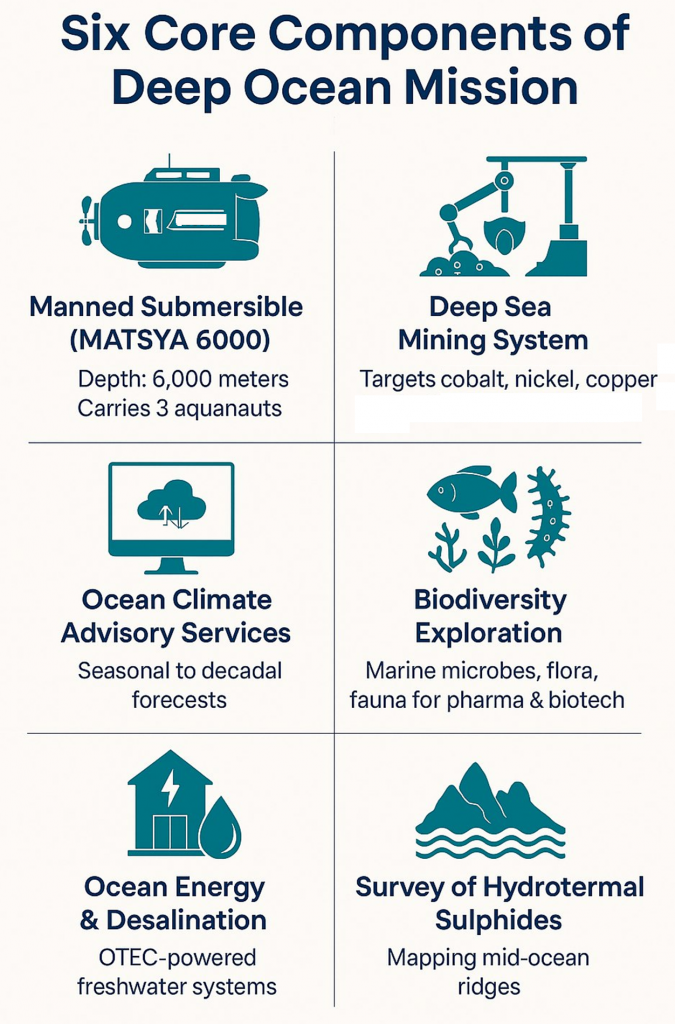
- Samudrayaan Project (Deep-Sea Mining & Manned Submersible): Development of a manned submersible to carry three people up to 6,000 metres depth.
- Creation of an Integrated Mining System for extracting polymetallic nodules in the Central Indian Ocean.
- Ocean Climate Change Advisory Services: Building observations and model suites to forecast climate variables from seasonal to decadal scales.
- Supports better planning for coastal communities and tourism.
- Biodiversity Exploration & Conservation: Bio-prospecting of deep-sea flora, fauna, and microbes.
- Promotes sustainable use of marine biological resources for fisheries and allied sectors.
- Deep Ocean Survey & Exploration: Identification of multi-metal hydrothermal sulphide sites along the mid-ocean ridges.
- Expands India’s access to deep-sea mineral reserves.
- Energy and Freshwater from the Ocean: Proof-of-concept for Ocean Thermal Energy Conversion (OTEC) powered desalination plants.
- Advances offshore renewable energy and water security.
- Advanced Marine Station for Ocean Biology: Establishment of a research hub for ocean biology and engineering.
- Facilitates innovation, incubation, and industrial applications of marine science.
Strategic Importance
- India’s unique maritime geography — with 11,098.81 km of coastline, nine coastal states, and 1,382 islands — makes it a natural leader in ocean science. The mission supports:
- Fisheries and aquaculture;
- Marine biotechnology;
- Coastal tourism;
- Energy security
- Prime Minister, in his recent Independence Day address, emphasized India’s push toward a ‘Samudra Manthan’ — a mission-mode effort to explore oil and gas reserves beneath the ocean floor.
- The Deep Ocean Mission is now being expanded into a National Deep Water Exploration Mission.