
Brief Context
Context Recently, China’s trade surplus surpassed $1 trillion in the first eleven months of 2025, underscoring China’s dominance in global manufacturing and exports. It also reveals underlying economic vulnerabilities and global trade distortions. Milestone and Its Meaning of $1 Trillion Trade Surplus It is the culmination of two decades of industrial scaling and policy continuity of China including the tightly integrated supply chains, infrastructure depth, and manufacturing ecosystem.
Source Content
Syllabus: GS3/Economy
Context
- Recently, China’s trade surplus surpassed $1 trillion in the first eleven months of 2025, underscoring China’s dominance in global manufacturing and exports.
- It also reveals underlying economic vulnerabilities and global trade distortions.
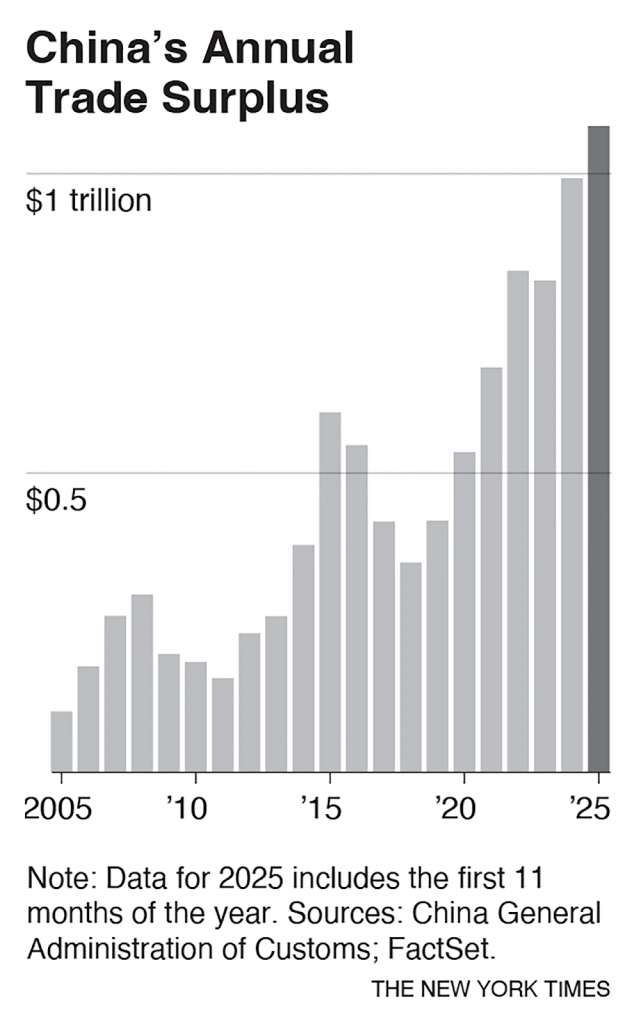
Milestone and Its Meaning of $1 Trillion Trade Surplus
- It is the culmination of two decades of industrial scaling and policy continuity of China including the tightly integrated supply chains, infrastructure depth, and manufacturing ecosystem.
- It is added by weaker Renminbi (exchange rate effects), but the fundamental driver remains production strength.
- It comes amid weak domestic demand and a volatile global trade environment.
Behind the Trade Surplus
- China’s Manufacturing Dominance: According to a study, no nation since the UK’s Industrial Revolution or the US post–World War II era has held such extensive control over global manufacturing like China.
- The global trade-to-GDP ratio has more than doubled since 1970, from 25% to over 60% by 2022, amplifying the consequences of China’s industrial strength.
- Over two decades, Chinese manufactured exports have grown 25-fold, powered by low labor costs, economies of scale, and state support.
- Export Composition: It reveals a decisive shift toward higher-value manufacturing.
- Strong sectors: Automobiles, integrated circuits, and advanced electronics.
- Weak sectors: Labor-intensive industries such as apparel, textiles, and toys.
- Changing Trade Geography: Shipments to the United States fell 29% year-on-year, largely due to renewed tariffs and softer American demand.
- But, overall exports surged because China diversified its markets, primarily towards the Global South and emerging economies.
- Transshipment through Southeast Asia, reflecting firms’ adaptive responses to tariff barriers.
- It represents both strategic resilience and an evolving global trade map where China’s influence extends deeper into developing economies.
| Do You Know?
– First ‘China Shock’: It reshaped global manufacturing after China joined the WTO in 2001. |
Policy Implications
- China’s Central Economic Work Conference (CEWC), the country’s annual economic policy meeting, aims to interpret the record surplus both as a success story and a warning signal. It likely includes:
- Rebalancing growth toward stronger domestic demand.
- Containing overcapacity and mitigating involution.
- Promoting technology upgrading and green manufacturing.
- Stabilizing confidence amid global headwinds.
- The central focus will remain on structural reform, innovation, and sustainable growth rather than headline surplus numbers, while trade tensions will frame discussions.
- The International Monetary Fund (IMF) attributes the surplus partly to a real depreciation of the Yuan, driven by China’s low inflation relative to its trading partners.
- The IMF urged China to stimulate domestic consumption and allow greater exchange rate flexibility to address these imbalances sustainably.
Global Implications of China’s $1 Trillion Trade Surplus
- Overcapacity and Global Friction: China’s expanding surplus intensifies domestic and international dilemmas.
- Trading partners accuse China of dumping goods and distorting markets, as recently France signals unease over China’s role in industries such as electric vehicles and green tech.
- Trade Imbalances and Currency Wars: The US and EU face record deficits with China.
- US deficit in 2025 projected at $480 billion, leading to renewed tariff escalation.
- Deflationary Pressures: China’s export-driven glut (EVs, steel, solar) depresses global industrial prices, raising risks of ‘imported deflation’ in OECD economies.
- Geoeconomic Repercussions: China’s surplus strengthens its global liquidity dominance, increased lending to Global South via Belt & Road and Yuan-denominated trade.
- But Western powers interpret this as ‘mercantilist aggression’, triggering industrial policy retaliation (e.g., EU’s CBAM).
- Asian Economies’ Realignment: ASEAN economies, Taiwan, and India benefit partially from supply chain shifts, but also face price competition and dumping risks.
Implications For India
- Rising Trade Deficit and Manufacturing Pressure: India’s trade deficit with China reached $95 billion in FY2025, as imports of electronics, solar components, and APIs surged.
- Domestic manufacturing under ‘Make in India’ and Production-Linked Incentive (PLI) schemes faces intensified competition from China’s cost-efficient exports.
- Investment and Supply Chain Realignment: Multinationals are diversifying from China. ‘China+1’ strategy, benefiting India, Vietnam, and Mexico.
- However, India lacks equivalent logistics and infrastructure, slowing relocation inflows.
- Currency & Inflation Spillovers: Yuan depreciation exerts deflationary pressure on global prices, including India’s imports, which helps inflation control but hurts local producers.
- Strategic Dependencies: India’s critical sectors (pharma APIs, electronics) remain dependent on Chinese imports.
India’s Strategic Responses
- Trade Diversification: FTAs with UAE, EU in progress, but need to prioritize ASEAN & Africa markets.
- India is pushing for supply chain diversification and self-reliance (Atmanirbhar Bharat) to reduce dependence on Chinese imports.
- Manufacturing Incentives: PLI in electronics, solar, semiconductors, and need to accelerate value-chain localization.
- Geopolitical Leverage: Need to use trade diplomacy to balance China’s dominance, as India is an active partner in QUAD & IPEF.
- India’s response to China’s trade surplus needs to twofold:
- Short-term: Tighten quality controls, incentivize domestic production, and monitor dumping practices.
- Long-term: Invest in R&D, skill development, and infrastructure to build globally competitive industries.