
Brief Context
Context Recent studies suggest that the Atlantic Meridional Overturning Circulation (AMOC) could weaken by nearly 59% by 2100 due to climate change and accelerated melting of Arctic ice. About Atlantic Meridional Overturning Circulation (AMOC) It is a large system of ocean currents that transports heat: Warm, salty water flows northward near the surface (e.g., Gulf Stream) Read More
Source Content
Syllabus: GS3/Environment & Climate Change
Context
- Recent studies suggest that the Atlantic Meridional Overturning Circulation (AMOC) could weaken by nearly 59% by 2100 due to climate change and accelerated melting of Arctic ice.
About Atlantic Meridional Overturning Circulation (AMOC)
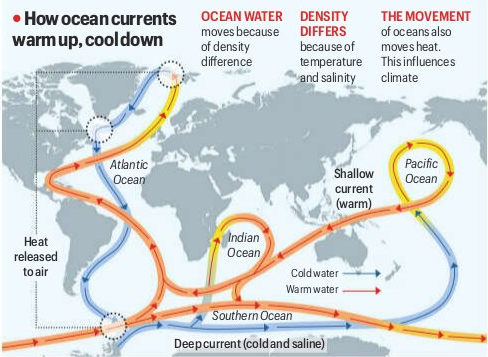
- It is a large system of ocean currents that transports heat:
- Warm, salty water flows northward near the surface (e.g., Gulf Stream)
- Cold, dense water sinks in the North Atlantic and flows southward at depth.
- It transfers enormous amounts of heat across the planet and helps regulate global weather patterns.
- It is often described as a global ocean ‘conveyor belt’.
- It influences Europe’s relatively mild climate, rainfall in Africa and South Asia, monsoon systems, marine ecosystems, and global heat distribution.
Why is the AMOC Weakening?
- Role of Climate Change: Human-induced global warming is accelerating the melting of Arctic sea ice and Greenland ice sheet.
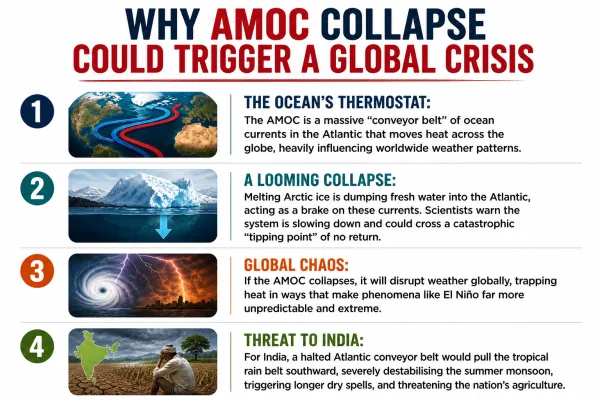
- It releases large volumes of freshwater (less salty and less dense) into the North Atlantic.
- Therefore, it does not sink easily, and disrupts the sinking mechanism that drives the AMOC, slowing down the entire circulation system.
- AMOC as a Climate ‘Tipping Point’: A tipping point refers to a threshold beyond which a system undergoes irreversible change.
- If the AMOC weakens beyond a critical level, it may collapse into a permanently sluggish state, and recovery may become impossible even if temperatures stabilize later.
- Possible Global Consequences: Extreme weather events, sea-level rise along North America, colder conditions in Europe, disruption of global rainfall systems, and increased climate instability
- AMOC has already weakened by nearly 15% over the last 50 years.
Connection Between AMOC and El Niño
- Though AMOC exists in the Atlantic Ocean, it strongly influences the Pacific climate system.
- A weaker AMOC alters global heat distribution, cools parts of the North Pacific, and disturbs atmospheric circulation patterns.
- It can intensify and destabilize El Niño events.
- Impact of Strong El Niño Events: Recent El Niño events such as 2015–16 and 2023–24 caused severe droughts, floods, agricultural losses, and heat waves.
- For India, El Niño generally weakens the southwest monsoon and affects crop production.
Why Does AMOC Matter for India?
- Threat to the Indian Monsoon: India’s monsoon system depends on temperature differences between land and ocean, and global heat circulation patterns.
- A slowdown of the AMOC shifts tropical rainfall belts southward, reducing moisture transport towards the Indian subcontinent.
- Weakening of monsoon winds reduced moisture flow from the Arabian Sea, and delayed or deficient monsoon rainfall.
- Agricultural Crisis: Nearly 50% of India’s population depends on agriculture, and large areas remain rain-fed.
- Weak monsoons can reduce crop yields, increase farmer distress, and threaten food security.
- Water Stress: India already faces groundwater depletion and uneven rainfall distribution. Reduced monsoon rainfall may intensify drinking water shortages, irrigation crises, and urban water stress.
- Increase in Extreme Events: An unstable climate system may produce erratic rainfall, flash floods, droughts, and heat waves.
Government and Scientific Responses
- India’s Climate Initiatives: India has launched several measures to improve climate resilience:
- National Action Plan on Climate Change (NAPCC) includes missions on water conservation, sustainable agriculture, and himalayan ecosystem protection.
- India Meteorological Department (IMD): Strengthening monsoon forecasting systems, and using climate models for early warning
- Disaster Management Efforts: The National Disaster Management Authority (NDMA) focuses on flood preparedness, drought management, and climate adaptation planning.